 info@sccoos.org
Category Archives: News

SCCOOS Celebrates Earth Day
Saturday, April 19, 2025 - 12:00amSCCOOS has road tripped north to participate in MERITO Foundation’s Earth Day Celebration Please stop by if you in the neighborhood, and tell us what you love about the ocean. Not in the neighborhood? Share anyway – https://forms.gle/ThK7hA1MWNqjvCvu8 #2025VenturaEarthDay


Loss of Funding Impacts
Wednesday, April 16, 2025 - 12:00amThe recent proposed budget cuts to NOAA for FY26 would impact IOOS and SCCOOS, leading to a loss of vital services for Southern California and beyond. See the recent flyer our office put together to help explain the impacts of the proposed cuts: See below or View/Download Flyer

SCCOOS News Just Released
Tuesday, April 08, 2025 - 12:00amCheck out what we have been up to

Apr 10 San Diego MPA Collaborative Mtg At Tijuana River Estuary
Tuesday, April 01, 2025 - 12:00amAgendaZoom – Mtg ID 880 470 6747
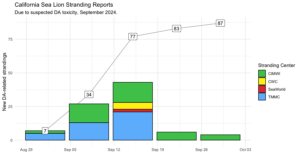
STARTED FEB 2025: Algal Bloom Effects Hundreds of Marine Mammals & Seabirds
Thursday, March 27, 2025 - 12:00amThe first marine mammal stranding related to this harmful algal bloom (HAB) was reported on February 21, 2025, and the currently the numbers are over 300. California Ocean Observing System Network HAB monitoring and Alert Program have pulled together their expertise and data to create this event-driven bulletin. Learn more in our flyer, most importantly […]

Save the Date – April 10 – San Diego MPA Collaborative Meeting
Monday, March 10, 2025 - 12:00am

Observing Seabirds Understanding Oceans
Thursday, January 02, 2025 - 12:00amWith funding from the National Science Foundation, Farallon Institute has created a page dedicated to seabirds as a ‘sentinel species’. Allowing scientists to observe seabirds to further our understanding of the health of the oceans.

California Multivariate Ocean Climate Indicator (MOCI) – December 2024 Update
Wednesday, December 18, 2024 - 12:00amAbove: Southern California MOCI, updated through September 2024. Large positive (red) values indicate warmer ocean conditions and weaker upwelling, which benefits Sardine recruitment. Negative (blue) values represent cooler ocean temperatures and strong upwelling, supporting a wide range of species, including kelp, copepods, krill, fish, and seabirds. The West Coast ocean conditions are highly variable, influenced […]
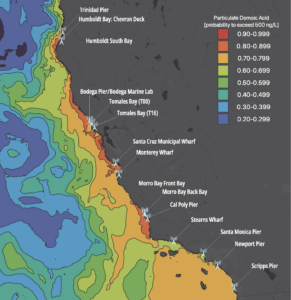
JUST RELEASED: California HAB Bulletin
Thursday, November 14, 2024 - 12:00amThe September 2024 California Harmful Algal Bloom Bulletin is now available! This latest edition includes a comprehensive summary of model outputs, real-time observations, and public health advisories to keep you informed about harmful algal bloom activity along the California coast. For a detailed summary and data figures and analysis, click the link below: September 2024 […]
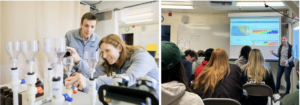
November PI Spotlight: Dr. Alexis (Ally) Pasulka
Wednesday, November 13, 2024 - 12:00amLearn more about Dr. Ally Pasulka‘s, Associate Professor at CalPoly in San Luis Obispo California, journey into ocean science as well as her contributions to our ocean observing system. “One of the things that excites me about involving undergraduate students in our Harmful Algal Bloom research is showing them how science directly impacts our communities.” […]