
 info@sccoos.org
January-February, 2026
Summary written by Dr. Kasia Kenitz & Dr. Clarissa Anderson on April 1, 2026
- SUMMARY:
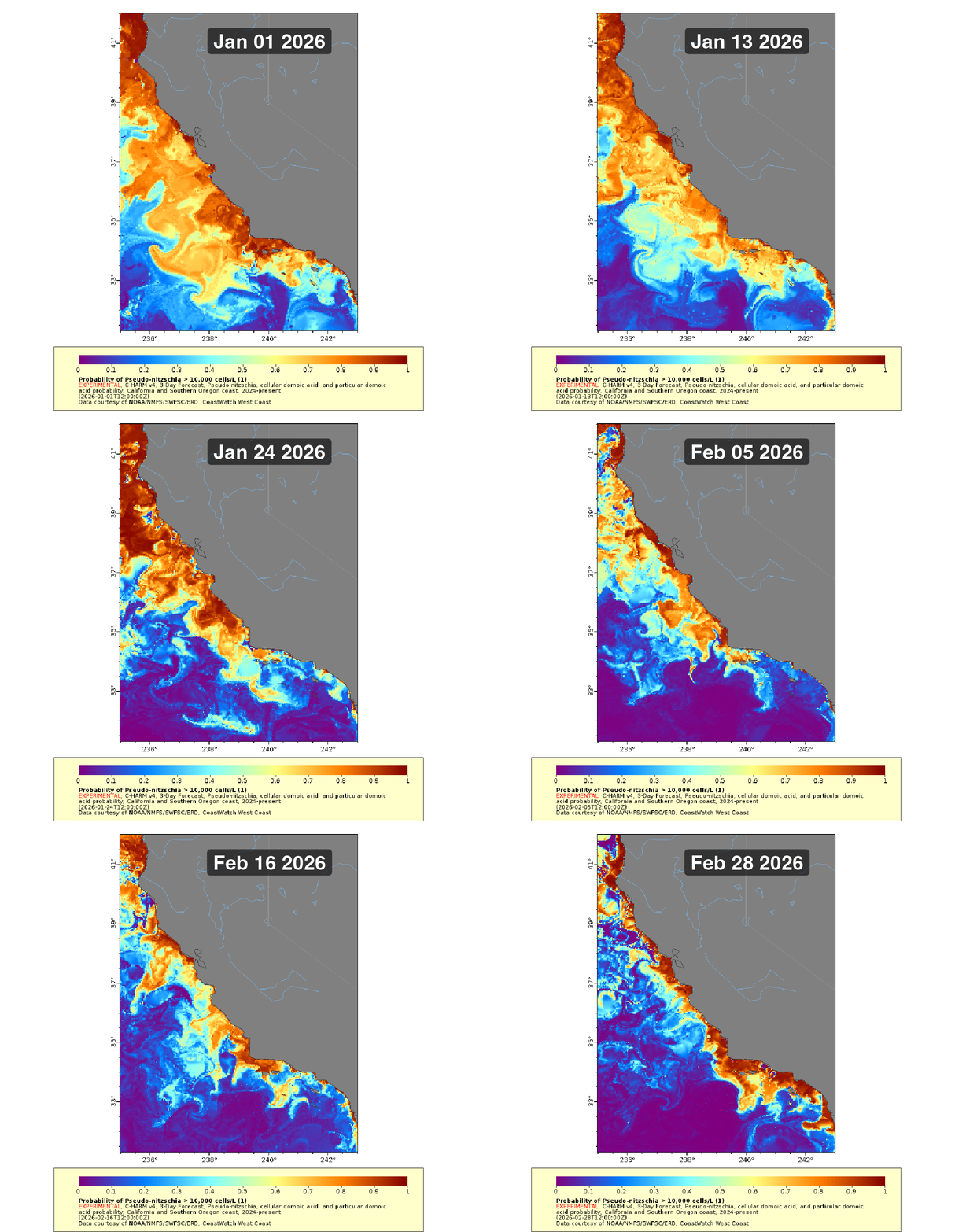
From January through February, C-HARM predicted predominantly low probabilities that Pseudo-nitzschia was exceeding alert thresholds in Southern California; this was followed by a sharp increase in the final days of February. In contrast, Central and Northern California high probabilities were predicted across both coastal and offshore regions in January, with elevated risk potential becoming largely confined to the coast by February. Weekly HABMAP sampling confirmed moderate Pseudo-nitzschia activity in Southern California, with localized alert-level exceedances at Newport Pier on 1/20 and Scripps Pier on 1/26 and 2/17. By late February, consistent with C-HARM predictions, abundances surged at most southern stations, notably reaching 51,975 cells/L at Newport Beach. While Central California saw less overall activity, a significant uptick in the Pseudo-nitzschia “delicatissima” group occurred at Cal Poly Pier on 1/19 (38,381 cells/L), and above-threshold levels of the “seriata” group at Santa Cruz Wharf on 1/28 coincided with particulate domoic acid (pDA) detections of 0.17 ng/mL. Imaging Flow Cytobots (IFCBs) further corroborated these late-February surges, recording high abundances at Del Mar, Scripps Pier, and Stearns Wharf, while also capturing a substantial Margalefidinium bloom at Santa Cruz Wharf in February. Other HAB taxa, including Prorocentrum, Akashiwo, and Lingulodinium polyedra, were present across all active IFCB and HABMAP stations but generally did not form dense blooms, with the exception of a short-lived Alexandrium spike (2,599 cells/L) at Newport Beach on 2/23. Monitoring by CDPH confirmed that no bivalve samples analyzed during this period exhibited elevated DA or PSP levels. All remaining advisories for sport-harvested Dungeness crab were lifted in January, and both commercial and recreational fisheries are now open statewide. Marine mammal strandings associated with suspected DA exposure remained low during this period, with 8 cases reported across Southern and Central California, the majority of which are believed to reflect chronic rather than acute exposure.
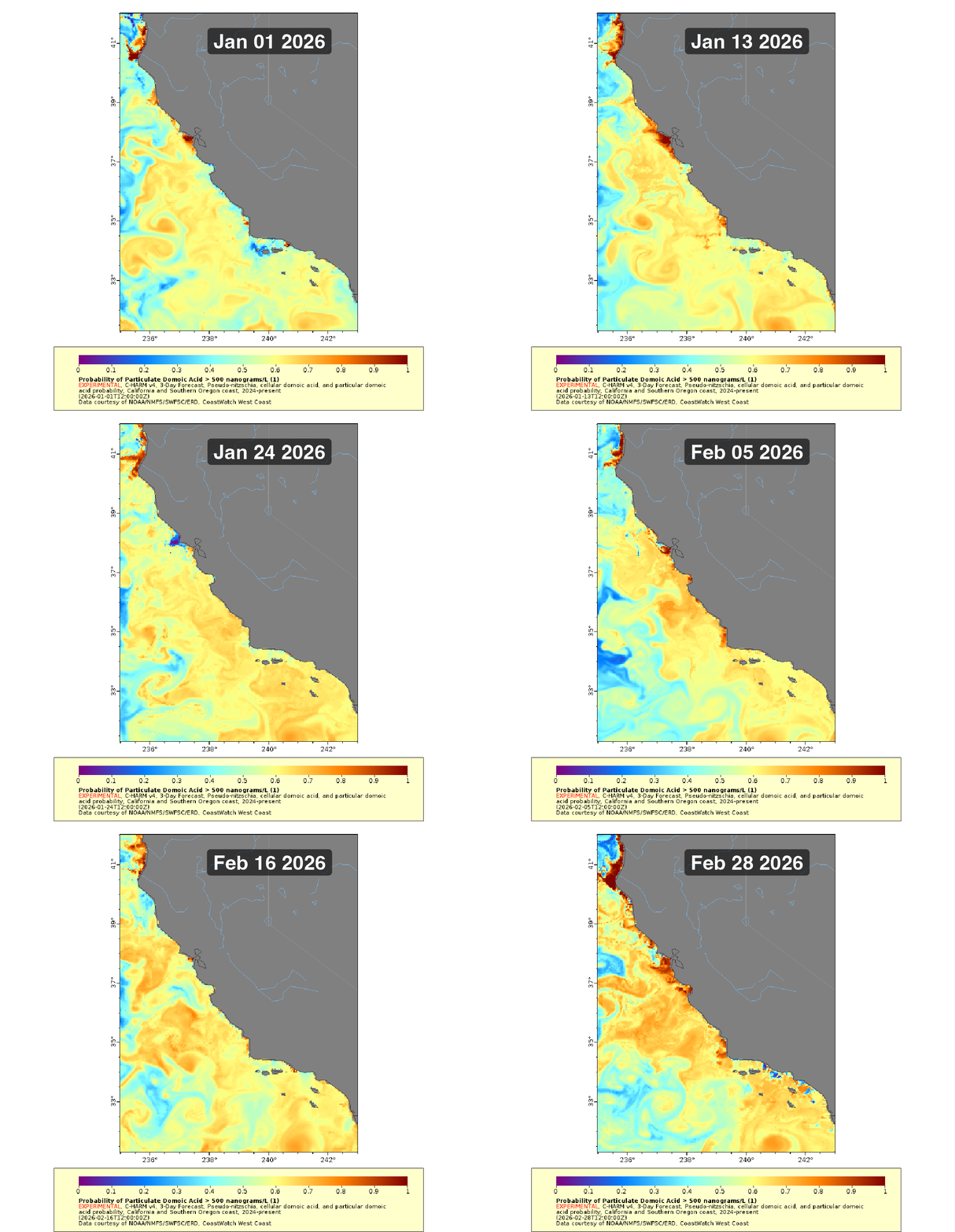
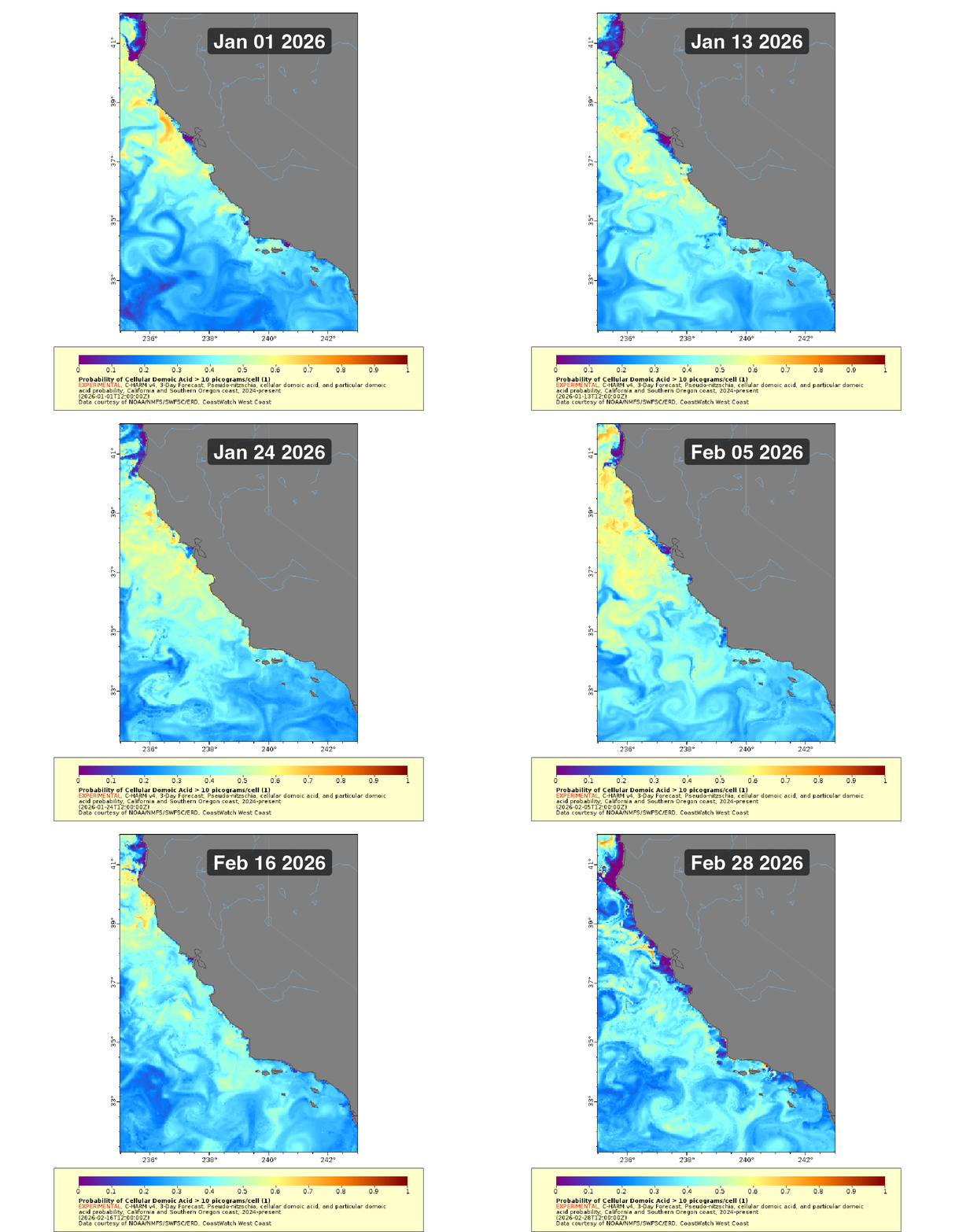
IMPORTANT NOTE: Pseudo-nitzschia activity surged in Central California mid-March, with Santa Cruz recording concerning P. australis levels (83,100 cells/L) and elevated DA (1.07 ng/ml) on 3/18. While abundances in the region have since begun to decrease, C-HARM predicts high risk will persist for Central and Northern California coastal and offshore waters. Additionally, emerging Alexandrium blooms have led to above-alert PSP levels in Marin and San Mateo Counties, triggering a new bivalve shellfish health advisory on 3/30, and in Sonoma County, triggering an advisory on 4/9. - C-HARM predictions for Southern California waters indicated low probabilities of Pseudo-nitzschia exceeding alert thresholds (10,000 cells/L) throughout January, with only occasional coastal hotspots. These low probabilities persisted through most of February before increasing sharply in the final days of the month. In contrast, Central and Northern California exhibited high probabilities across both coastal and offshore regions during January, followed by a decline in offshore probabilities in February, and elevated risk becoming largely confined to coastal areas. Predicted cellular DA levels remained relatively low at the start of January but increased substantially in Central and Northern California by the end of the month; in February, coastal regions – particularly San Mateo, San Francisco, Marin, and Humboldt counties – generally showed lower probabilities, while elevated risk persisted offshore. Meanwhile, the probability of particulate DA (pDA) exceeding alert thresholds remained high across much of California waters from January through February, with coastal hotspots emerging in mid-January and again toward the end of February, primarily extending from Ventura County up to Humboldt County.
- Weekly HABMAP sampling of phytoplankton showed moderate Pseudo-nitzschia activity in Southern California through January and February, consistent with C-HARM, with this genus detected at most sites but largely staying below alert-level thresholds. On 1/20, the Pseudo-nitzschia “seriata” size group marginally exceeded the threshold at Newport Pier (10,395 cells/L), while Scripps Pier reported above-alert concentrations of the “delicatessima” group on 1/26 (15,589 cells/L) and 2/17 (10,667 cells/L). By the end of February, in line with C-HARM predictions, Pseudo-nitzschia increased at most Southern California stations, exceeding thresholds for the “delicatessima” group at Stearns Wharf (10,420 cells/L) and Newport Beach (51,975 cells/L), and for the “seriata” group at Newport (12,994 cells/L). Central California experienced less overall activity, though a substantial uptick in the “delicatessima” group was recorded at Cal Poly Pier on 1/19 (38,381 cells/L), followed by above-threshold levels of the “seriata” group at Santa Cruz on 1/28 (10,750 cells/L), which coincided with pDA detections of 0.17 ng/mL. Notably, no pDA was detected at any Southern California sites during this timeframe. While other HAB taxa, including Margalefidinium, Prorocentrum, Akashiwo, Gonyaulax, and Lingulodinium polyedra, were present at Southern California sites in January, they did not form dense blooms; however, a short-lived uptick in Alexandrium reached 2,599 cells/L at Newport Beach on 2/23, and Margalefidinium blooms were recorded at Santa Cruz and Cal Poly in February.
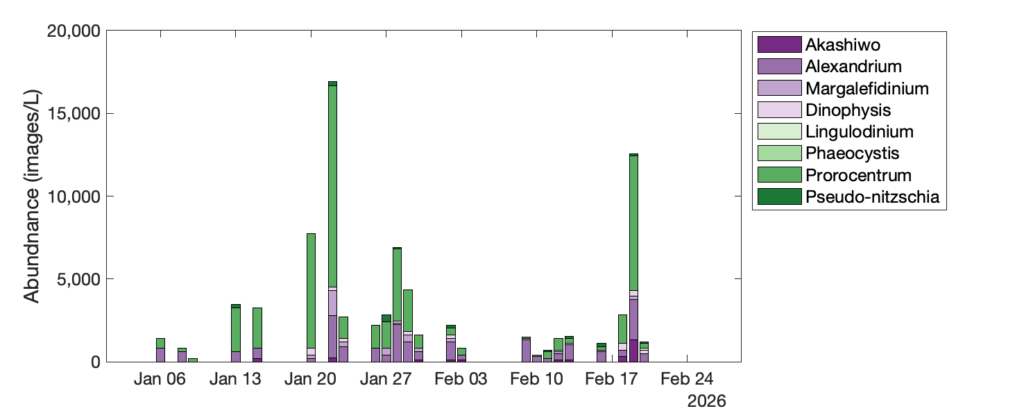
- The Imaging Flow Cytobots (IFCBs) – robotic microscopes recording hourly observations at a subset of HABMAP piers and an offshore location at the Del Mar mooring recorded high Pseudo-nitzschia abundances at the end of February, consistent with HABMAP, with Del Mar reaching 15,000–21,000 images/L (roughly 30,000–52,500 cells/L), Scripps Pier at 5,000–16,000 images/L (roughly 10,000–40,000 cells/L), and Stearns Wharf at 10,000–41,000 images/L (roughly 20,000–102,500 cells/L). Unfortunately, the Newport Beach IFCB was not operational through much of this time period. IFCBs deployed through January-February confirm that Akashiwo, Margalefidinium, and Prorocentrum were detected across all active stations, and a substantial Margalefidinium bloom was also captured at Santa Cruz Wharf in February.
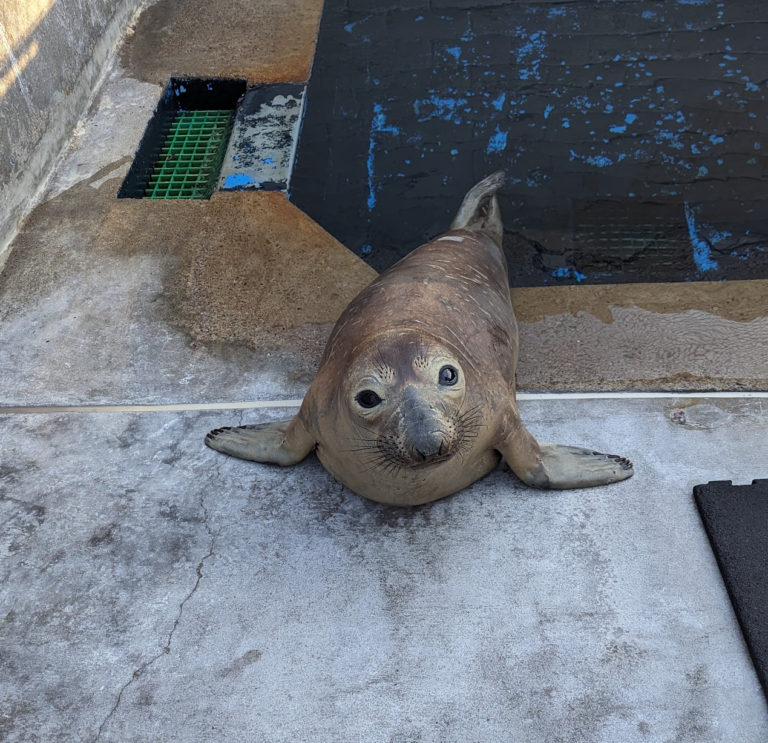
- Marine Mammal Strandings associated with suspected DA exposure remained low from January through February. A total of 8 suspect DA-related California sea lion strandings were reported over the entire period across the Southern and Central California coast. The continued absence of widespread acute DA cases is consistent with relatively low Pseudo-nitzschia activity observed at HABMAP and IFCB coastal sampling stations, as well as low pDA levels measured along the coast. Most cases appear to be chronic DA cases despite the fact that C-HARM showed elevated DA risk in offshore waters during this period.
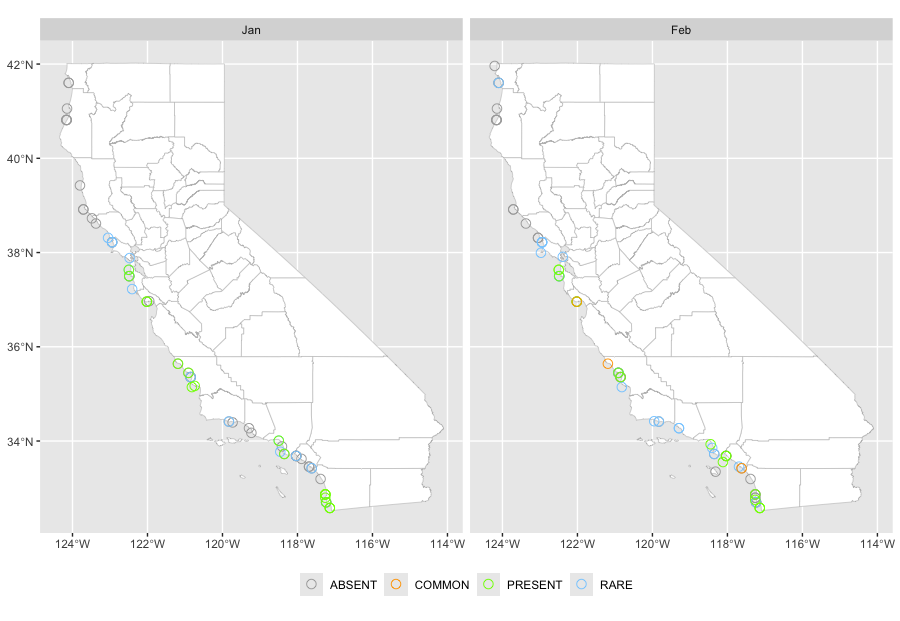
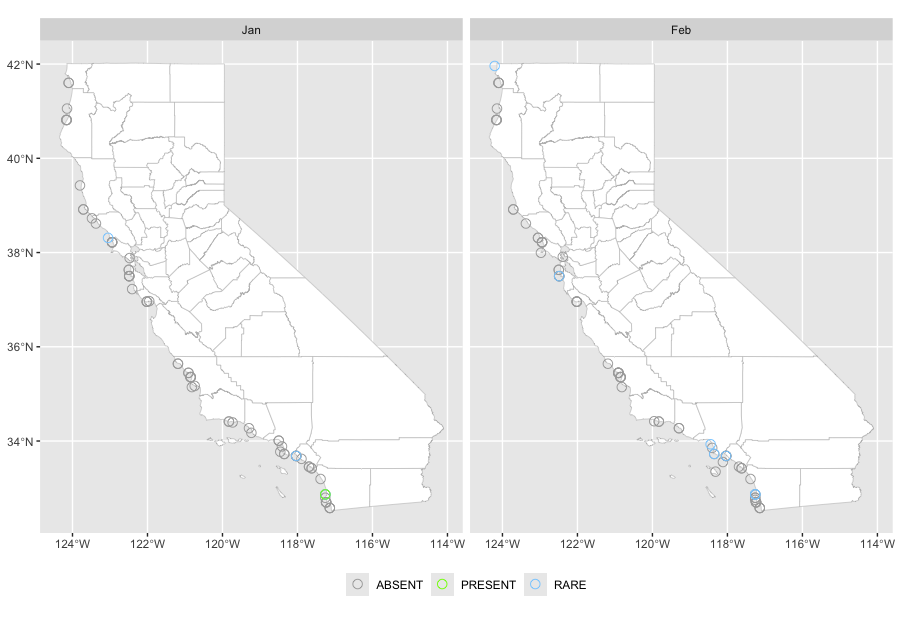
- California Department of Public Health (CDPH) conducts its own phytoplankton monitoring and shellfish and seafood testing for PSP toxins and DA. CDPH monitoring reported that Pseudo-nitzschia was recorded at “rare” or “present” levels across most Southern and Central California monitoring sites through much of January. By February, its relative abundance increased to “common” levels in Orange, San Luis Obispo, and Santa Cruz counties. Alexandrium remained largely absent along the coast, appearing only at “rare” levels in Southern California during January and February, with a single “present” observation at Scripps Pier on 1/5. No bivalve samples analyzed during this period exhibited elevated DA or PSP levels, and all remaining advisories for sport-harvested Dungeness crab were lifted in January, leaving both commercial and recreational fisheries open statewide.
- **For current bivalve shellfish advisories please see the CDPH advisory map: https://experience.arcgis.com/experience/394836318cfe4f7494e1c09097a43559
On April 9, CDPH issued an advisory warning the public not to consume sport-harvested mussels, clams, scallops, or oysters from Sonoma County due to dangerous levels of PSP toxins detected in shellfish from this area. On March 30, CDPH issued an advisory warning the public not to consume sport-harvested mussels, clams, scallops, or oysters from Marin or San Mateo Counties due to dangerous levels of PSP toxins detected in shellfish in those areas. Ongoing advisories against the consumption of sport-harvested razor clams from Humboldt County, as well as mussels, clams, scallops, or oysters from the Northern Channel Islands, remain in place. Both advisories continue due to previously detected high DA levels.
- SUMMARY:
Particulate Domoic Acid
Particulate domoic acid (pDA) is the measurement of total domoic acid toxin that is potentially extant in a given area. This forecast provides a probability for where that concentration of toxin is predicted to exceed the threshold that classifies a Harmful Algal Bloom (> 500 nanograms per liter).
The C-HARM v4 model generates nowcast and forecasts of the probability of Pseudo-nitzschia concentrations of in excess of 10,000 cells/L, the probability of particulate domoic acid > 500 nanograms/L, and the probability of cellular domoic acid > 10 picograms/cell in California and Southern Oregon coastal waters. Inputs for the model include near real-time satellite observations, gap-filled chlorophyll a, 486nm reflectance, and 551nm reflectance fields from the S-NPP NOAA VIIRS sensor plus nowcast and forecast data of surface salinity, sea surface temperature, and surface currents from WCOFS ROMS.
Cellular Domoic Acid
Cellular domoic acid (cDA) is the measure of total domoic acid toxin calculated per cell of Pseudo-nitzschia. This forecast provides a probability for where those cells are expected to be producing toxin at high levels (> 10 picograms per cell).
The C-HARM v4 model generates nowcast and forecasts of the probability of Pseudo-nitzschia concentrations of in excess of 10,000 cells/L, the probability of particulate domoic acid > 500 nanograms/L, and the probability of cellular domoic acid > 10 picograms/cell in California and Southern Oregon coastal waters. Inputs for the model include near real-time satellite observations, gap-filled chlorophyll a, 486nm reflectance, and 551nm reflectance fields from the S-NPP NOAA VIIRS sensor plus nowcast and forecast data of surface salinity, sea surface temperature, and surface currents from WCOFS ROMS.
Pseudo-nitzschia
Pseudo-nitzschia is a neurotoxin producing diatom that is observed along the California Coast. Blooms of this phytoplankton can be detrimental to surrounding marine ecosystems. This forecast provides a probability for where the concentration of cells in the water exceed the threshold of a Harmful Algal Bloom ( > 10,000 cells/L).
The C-HARM v4 model generates nowcast and forecasts of the probability of Pseudo-nitzschia concentrations of in excess of 10,000 cells/L, the probability of particulate domoic acid > 500 nanograms/L, and the probability of cellular domoic acid > 10 picograms/cell in California and Southern Oregon coastal waters. Inputs for the model include near real-time satellite observations, gap-filled chlorophyll a, 486nm reflectance, and 551nm reflectance fields from the S-NPP NOAA VIIRS sensor plus nowcast and forecast data of surface salinity, sea surface temperature, and surface currents from WCOFS ROMS.
California Harmful Algal Bloom Monitoring & Alert Program
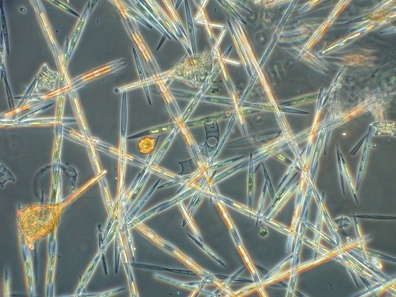
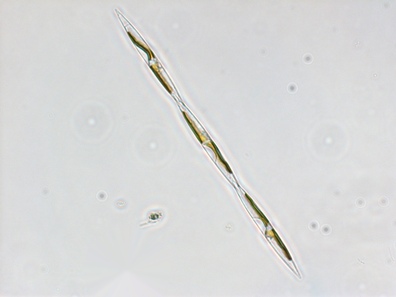
Differentiating Pseudo-nitzschia species by light microscopy is difficult. For this reason, Pseudo-nitzschia “seriata” does not refer to an actual species but rather the larger size class of Pseudo-nitzschia, which is generally a more toxigenic group of species. Alternatively, Pseudo-nitzschia “delicatissima” refers to the smaller size class that is generally non-toxigenic. The dashed line on the plots demarcates the 10,000 cells/L “bloom” threshold designated here for Pseudo-nitzschia populations only.
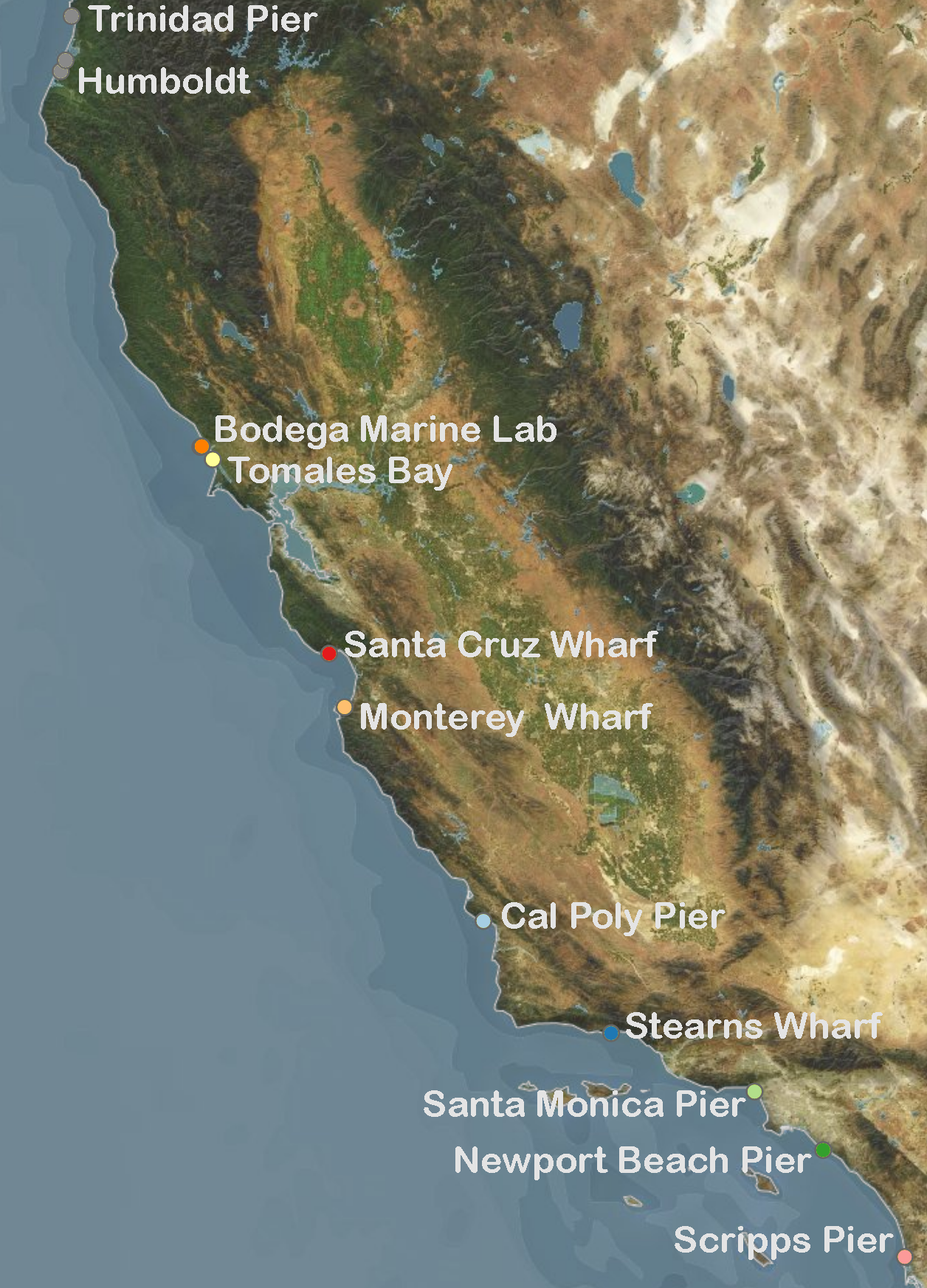
Data for some stations are not shown as they are not yet recorded in the public HABMAP archive.
Note for Google Chrome users:
There is a known issue rendering the HABMAP plot. Data can be viewed in alternative browsers.
These time series focus on data collected through the scope of this bulletin and the 12 month period that precedes it. Explore the variables and regions that make up the CalHABMAP collective dataset using the plot controls.
More information and data visualizations on the statewide HAB network and forecasting system is found on the California HABMAP website and on the SCCOOS Harmful Algal Bloom page.
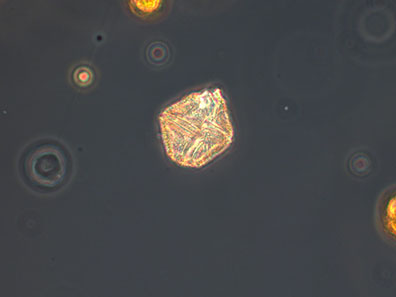
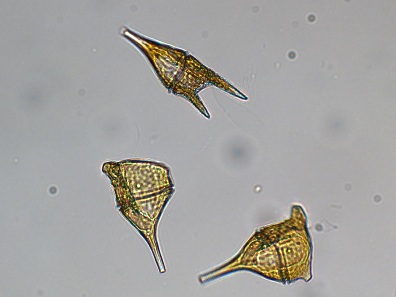
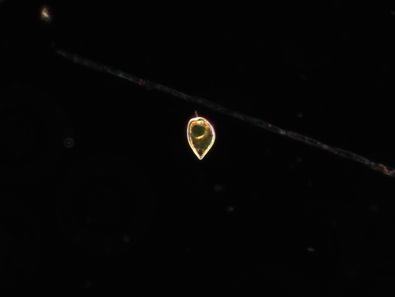
A network of Imaging FlowCytobots (IFCBs) continuously photographs particles, such as plankton, in the water. Using machine learning, plankton species can be automatically identified. This will help improve the ability to detect and respond to Harmful Algal Blooms, including the ability to assess conditions that may lead to toxin production or blooms of toxin-producing algae.
These data, coupled with the image classification algorithms developed in collaboration with SCCOOS and CeNCOOS, allow for estimates of species composition over time. The time series below depict sampling outcomes across several California sites. Support provided by NOAA IOOS and CA OPC.
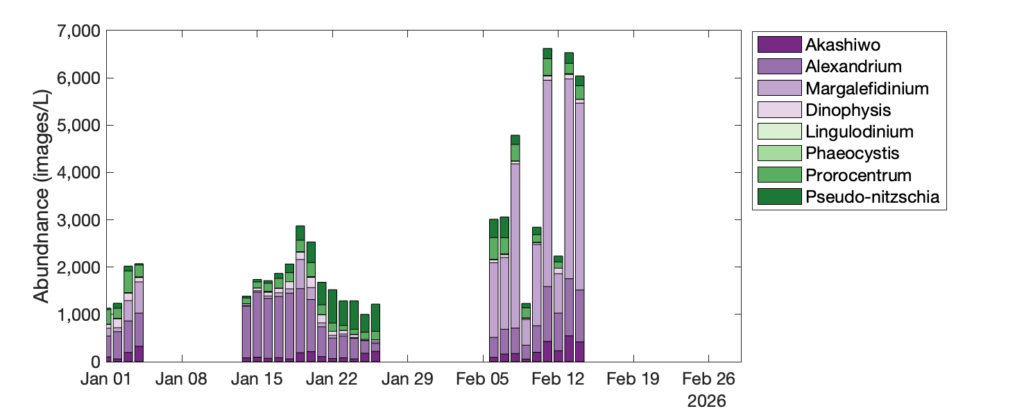
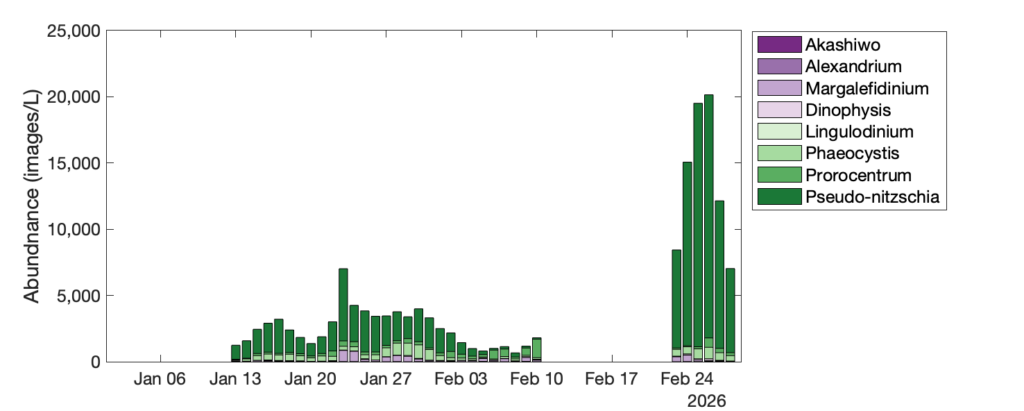
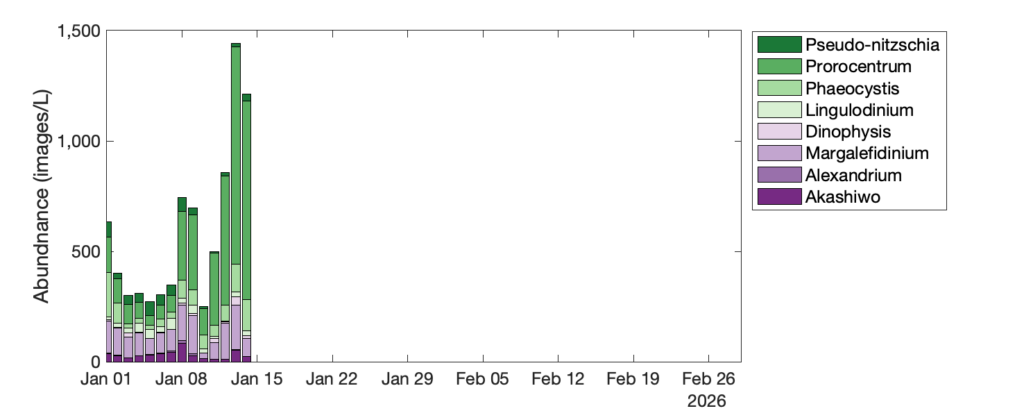
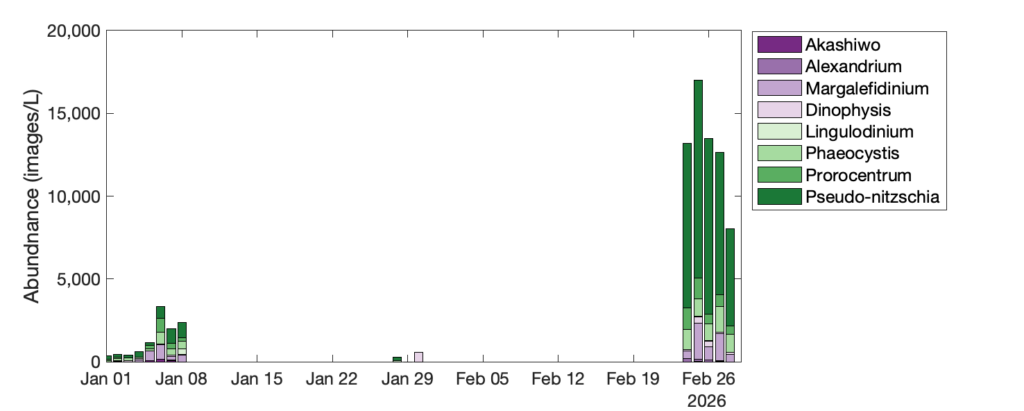
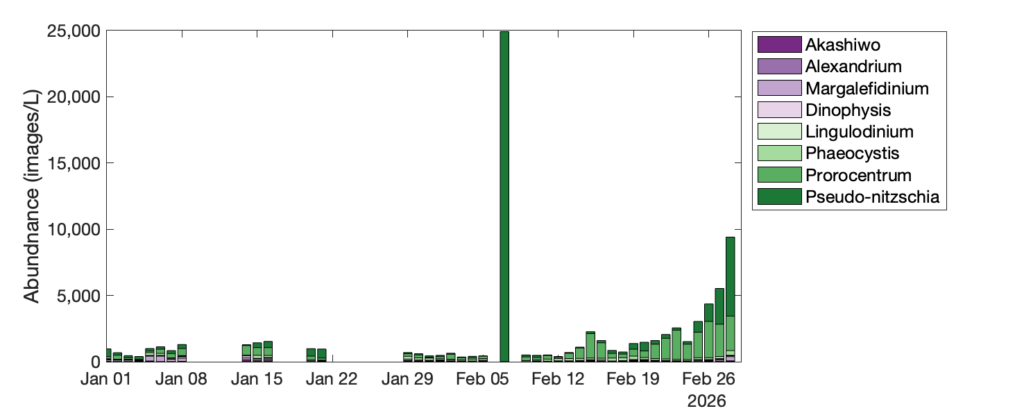
Additional images and data are available on the IFCB dashboard.
Each month, water samples are collected by volunteers and sent to the California Department of Public Health (CDPH) for analysis. The relative abundance of DA-producing Pseudo-nitzschia ‘seriata’ size class (upper) and PSP toxin-producing Alexandrium spp. (lower) are catalogued from sample locations within each county.
____
CDPH is warning people not to eat the internal organs of sport-harvested Dungeness crab from specific coastal areas of Northern California due to dangerous levels of domoic acid.
____
CDPH is warning people not to eat the internal organs of sport-harvested Dungeness crab from specific coastal areas of Northern California due to dangerous levels of domoic acid.
____
CDPH has lifted its warning to not eat the viscera of sport-harvested Dungeness crab caught from one of the coastal areas of Northern California perviously restricted.
Percent composition categories help us look at phytoplankton trends across an entire region to evaluate risk of biotoxin presence. Many other factors contribute to our evaluation of risk in an area. These samples are posted for informational purposes only. They are not intended to inform the public of the presence or lack of risk. For the latest health advisory information, see the CDPH Health Advisory Map below.
Water Sample Detailed Data
| Date_Sampled | Sample_Site | Latitude | Longitude | PN_Percent_Comp | PN_Density | AL_Percent_Comp | AL_Density |
|---|---|---|---|---|---|---|---|
| 2026-01-05 | Wilson Creek | 41.6016 | -124.10232 | 0 | ABSENT | 0 | ABSENT |
| 2026-01-02 | San Simeon Pier | 35.64078 | -121.18803 | 2 | PRESENT | 0 | ABSENT |
| 2026-01-07 | Imperial Beach Pier | 32.57962 | -117.13742 | 2 | PRESENT | 0 | ABSENT |
| 2026-01-08 | Dana Pt. Harbor | 33.4562 | -117.6915 | 0 | ABSENT | 0 | ABSENT |
| 2026-01-04 | Point Arena Pier | 38.9147 | -123.71124 | 0 | ABSENT | 0 | ABSENT |
| 2026-01-02 | Bolsa Chica | 33.68344 | -118.03494 | 0 | ABSENT | 0 | ABSENT |
| 2026-01-06 | Palos Verdes, OFFSHORE | 33.72522 | -118.35175 | 0 | ABSENT | 0 | ABSENT |
| 2026-01-07 | Goleta Pier | 34.41287 | -119.82814 | 0 | ABSENT | 0 | ABSENT |
| 2026-01-09 | Pacifica Pier | 37.63351 | -122.49811 | 0.5 | RARE | 0 | ABSENT |
| 2026-01-05 | La Jolla, Scripps Pier | 32.86716 | -117.25759 | 3 | PRESENT | 1 | PRESENT |
| 2026-01-12 | Humboldt Bay, Indian Is. Ch. | 40.81371 | -124.15952 | 0 | ABSENT | 0 | ABSENT |
| 2026-01-12 | Morro Bay, Boat Launch | 35.35703 | -120.85021 | 0 | ABSENT | 0 | ABSENT |
| 2026-01-20 | Tomales Bay, Lease #M430-15 | 38.2176 | -122.9437 | 0.5 | RARE | 0 | ABSENT |
| 2026-01-20 | Humboldt Bay, Indian Is. Ch. | 40.81371 | -124.15952 | 0 | ABSENT | 0 | ABSENT |
| 2026-01-31 | Pillar Point Harbor | 37.49883 | -122.48753 | 1 | PRESENT | 0 | ABSENT |
| 2026-01-13 | Palos Verdes Rocky Pt Offshore | 33.77258 | -118.45833 | 0.5 | RARE | 0 | ABSENT |
| 2026-01-12 | Oceanside Harbor | 33.19435 | -117.38415 | 0 | ABSENT | 0 | ABSENT |
| 2026-01-14 | Pillar Point Harbor | 37.49883 | -122.48753 | 0 | ABSENT | 0 | ABSENT |
| 2026-01-29 | Cayucos Pier | 35.44647 | -120.90775 | 5 | PRESENT | 0 | ABSENT |
| 2026-01-21 | Santa Cruz Wharf | 36.95739 | -122.01764 | 2 | PRESENT | 0 | ABSENT |
| 2026-01-28 | Bodega Harbor, USCG Dock | 38.31277 | -123.0513 | 0.5 | RARE | 0.5 | RARE |
| 2026-01-26 | Tomales Bay, Lease #M430-15 | 38.2176 | -122.9437 | 0.5 | RARE | 0 | ABSENT |
| 2026-01-29 | San Luis Obispo, Cal Poly Pier | 35.16949 | -120.74082 | 5 | PRESENT | 0 | ABSENT |
| 2026-01-26 | Morro Bay, Boat Launch | 35.35703 | -120.85021 | 0 | ABSENT | 0 | ABSENT |
| 2026-01-05 | Morro Bay, Boat Launch | 35.35703 | -120.85021 | 0 | ABSENT | 0 | ABSENT |
| 2026-01-06 | Tomales Bay, Lease #M430-15 | 38.2176 | -122.9437 | 0 | ABSENT | 0 | ABSENT |
| 2026-01-07 | Humboldt Bay, Indian Is. Ch. | 40.81371 | -124.15952 | 0 | ABSENT | 0 | ABSENT |
| 2026-01-12 | Tomales Bay, Lease #M430-15 | 38.2176 | -122.9437 | 0 | ABSENT | 0 | ABSENT |
| 2026-01-20 | Morro Bay, Boat Launch | 35.35703 | -120.85021 | 0.5 | RARE | 0 | ABSENT |
| 2026-01-12 | La Jolla, Scripps Pier | 32.86716 | -117.25759 | 1 | PRESENT | 0.5 | RARE |
| 2026-01-14 | Ventura, Channel Is. Harbor | 34.17378 | -119.22913 | 0 | ABSENT | 0 | ABSENT |
| 2026-01-14 | San Diego Bay, U.S. Navy Pier | 32.7 | -117.236 | 0 | ABSENT | 0 | ABSENT |
| 2026-01-14 | Kashia Coastal Reserve | 38.61616 | -123.37475 | 0 | ABSENT | 0 | ABSENT |
| 2026-01-16 | Imperial Beach Pier | 32.57962 | -117.13742 | 6 | PRESENT | 0 | ABSENT |
| 2026-01-14 | Shell Beach, Sea Ranch | 38.72636 | -123.48052 | 0 | ABSENT | 0 | ABSENT |
| 2026-01-14 | Santa Cruz, Capitola Pier | 36.96903 | -121.95314 | 0 | ABSENT | 0 | ABSENT |
| 2026-01-24 | Pillar Point Harbor | 37.49883 | -122.48753 | 0.5 | RARE | 0 | ABSENT |
| 2026-01-26 | Humboldt Bay, Indian Is. Ch. | 40.81371 | -124.15952 | 0 | ABSENT | 0 | ABSENT |
| 2026-01-07 | Santa Cruz Wharf | 36.95739 | -122.01764 | 0 | ABSENT | 0 | ABSENT |
| 2026-01-08 | San Diego Bay, U.S. Navy Pier | 32.7 | -117.236 | 0 | ABSENT | 0 | ABSENT |
| 2026-01-08 | San Simeon Pier | 35.64078 | -121.18803 | 0 | ABSENT | 0 | ABSENT |
| 2026-01-12 | Santa Monica Pier | 34.0072 | -118.4985 | 2 | PRESENT | 0 | ABSENT |
| 2026-01-12 | Mendocino, Noyo Harbor | 39.42448 | -123.8008 | 0 | ABSENT | 0 | ABSENT |
| 2026-01-09 | Bolsa Chica | 33.68344 | -118.03494 | 0 | ABSENT | 0 | ABSENT |
| 2026-01-20 | Palos Verdes, OFFSHORE | 33.72522 | -118.35175 | 6 | PRESENT | 0 | ABSENT |
| 2026-01-21 | Point Arena Pier | 38.9147 | -123.71124 | 0 | ABSENT | 0 | ABSENT |
| 2026-01-20 | Wilson Creek | 41.6016 | -124.10232 | 0 | ABSENT | 0 | ABSENT |
| 2026-01-29 | Manhattan Beach Pier | 33.8856 | -118.4137 | 0 | ABSENT | 0 | ABSENT |
| 2026-01-19 | La Jolla, Scripps Pier | 32.86716 | -117.25759 | 4 | PRESENT | 0 | ABSENT |
| 2026-01-30 | San Clemente Pier | 33.4217 | -117.6218 | 0.5 | RARE | 0 | ABSENT |
| 2026-01-30 | Imperial Beach Pier | 32.57962 | -117.13742 | 5 | PRESENT | 0 | ABSENT |
| 2026-01-30 | Bolsa Chica | 33.68344 | -118.03494 | 0 | ABSENT | 0 | ABSENT |
| 2026-01-28 | Santa Cruz Wharf | 36.95739 | -122.01764 | 8 | PRESENT | 0 | ABSENT |
| 2026-01-27 | Pillar Point Harbor | 37.49883 | -122.48753 | 0 | ABSENT | 0 | ABSENT |
| 2026-01-27 | Bean Hollow State Beach | 37.2243 | -122.4095 | 0.5 | RARE | 0 | ABSENT |
| 2026-01-29 | Trinidad Pier | 41.05528 | -124.14583 | 0 | ABSENT | 0 | ABSENT |
| 2026-01-30 | Dana Pt. Harbor | 33.4562 | -117.6915 | 0 | ABSENT | 0 | ABSENT |
| 2026-01-26 | La Jolla, Scripps Pier | 32.86716 | -117.25759 | 5 | PRESENT | 0.5 | RARE |
| 2026-01-18 | Pacific Beach Pier | 32.79599 | -117.25834 | 5 | PRESENT | 0 | ABSENT |
| 2026-01-20 | Port San Luis, Diablo Cove | 35.14469 | -120.8166 | 1 | PRESENT | 0 | ABSENT |
| 2026-01-24 | Richardson Bay | 37.8826 | -122.4761 | 0.5 | RARE | 0 | ABSENT |
| 2026-01-22 | San Diego Bay, U.S. Navy Pier | 32.7 | -117.236 | 1 | PRESENT | 0 | ABSENT |
| 2026-01-23 | Bolsa Chica | 33.68344 | -118.03494 | 0.5 | RARE | 0.5 | RARE |
| 2026-01-28 | Santa Monica Pier | 34.0072 | -118.4985 | 0.5 | RARE | 0 | ABSENT |
| 2026-01-15 | San Clemente Pier | 33.4217 | -117.6218 | 0 | ABSENT | 0 | ABSENT |
| 2026-01-16 | Santa Barbara, Mohawk Reef | 34.3944 | -119.73 | 0 | ABSENT | 0 | ABSENT |
| 2026-01-16 | Bolsa Chica | 33.68344 | -118.03494 | 0 | ABSENT | 0 | ABSENT |
| 2026-01-19 | Ventura Pier | 34.27208 | -119.29275 | 0 | ABSENT | 0 | ABSENT |
| 2026-01-25 | Pacifica Pier | 37.63351 | -122.49811 | 1 | PRESENT | 0 | ABSENT |
| 2026-01-03 | Cayucos Pier | 35.44647 | -120.90775 | 0 | ABSENT | 0 | ABSENT |
| 2026-01-06 | Newport Bay, Back Bay | 33.62172 | -117.89309 | 0 | ABSENT | 0 | ABSENT |
| 2026-01-28 | San Diego Bay, U.S. Navy Pier | 32.7 | -117.236 | 0.5 | RARE | 0 | ABSENT |
| 2026-01-21 | Goleta Pier | 34.41287 | -119.82814 | 0.5 | RARE | 0 | ABSENT |
| 2026-02-02 | Morro Bay, Boat Launch | 35.35703 | -120.85021 | 3 | PRESENT | 0 | ABSENT |
| 2026-02-02 | Humboldt Bay, Indian Is. Ch. | 40.81371 | -124.15952 | 0 | ABSENT | 0 | ABSENT |
| 2026-02-02 | Tomales Bay, Lease #M430-15 | 38.2176 | -122.9437 | 0.5 | RARE | 0 | ABSENT |
| 2026-02-09 | Tomales Bay, Lease #M430-15 | 38.2176 | -122.9437 | 0.5 | RARE | 0 | ABSENT |
| 2026-02-10 | Bodega Harbor, USCG Dock | 38.31277 | -123.0513 | 0 | ABSENT | 0 | ABSENT |
| 2026-02-01 | Cayucos Pier | 35.44647 | -120.90775 | 2 | PRESENT | 0 | ABSENT |
| 2026-02-09 | Humboldt Bay, Indian Is. Ch. | 40.81371 | -124.15952 | 0 | ABSENT | 0 | ABSENT |
| 2026-02-04 | Goleta Pier | 34.41287 | -119.82814 | 0.5 | RARE | 0 | ABSENT |
| 2026-02-02 | Point Arena Pier | 38.9147 | -123.71124 | 0 | ABSENT | 0 | ABSENT |
| 2026-02-04 | Santa Cruz Wharf | 36.95739 | -122.01764 | 10 | COMMON | 0 | ABSENT |
| 2026-02-02 | La Jolla, Scripps Pier | 32.86716 | -117.25759 | 0 | ABSENT | 0 | ABSENT |
| 2026-02-09 | Morro Bay, Boat Launch | 35.35703 | -120.85021 | 0 | ABSENT | 0 | ABSENT |
| 2026-02-01 | San Simeon Pier | 35.64078 | -121.18803 | 10 | COMMON | 0 | ABSENT |
| 2026-02-04 | San Diego Bay, U.S. Navy Pier | 32.7 | -117.236 | 0 | ABSENT | 0 | ABSENT |
| 2026-02-04 | Imperial Beach Pier | 32.57962 | -117.13742 | 3 | PRESENT | 0 | ABSENT |
| 2026-02-17 | Humboldt Bay, Indian Is. Ch. | 40.81371 | -124.15952 | 0 | ABSENT | 0 | ABSENT |
| 2026-02-14 | Pillar Point Harbor | 37.49883 | -122.48753 | 0.5 | RARE | 0 | ABSENT |
| 2026-02-17 | Morro Bay, Boat Launch | 35.35703 | -120.85021 | 0 | ABSENT | 0 | ABSENT |
| 2026-02-16 | Tomales Bay, Lease #M430-15 | 38.2176 | -122.9437 | 0.5 | RARE | 0 | ABSENT |
| 2026-02-13 | Hunter Rock, north | 41.95971 | -124.2079 | 0 | ABSENT | 0.5 | RARE |
| 2026-02-18 | Goleta Pier | 34.41287 | -119.82814 | 0 | ABSENT | 0 | ABSENT |
| 2026-02-09 | La Jolla, Scripps Pier | 32.86716 | -117.25759 | 0 | ABSENT | 0 | ABSENT |
| 2026-02-23 | Tomales Bay, Lease #M430-15 | 38.2176 | -122.9437 | 0.5 | RARE | 0 | ABSENT |
| 2026-02-23 | Morro Bay, Boat Launch | 35.35703 | -120.85021 | 0 | ABSENT | 0 | ABSENT |
| 2026-02-23 | Humboldt Bay, Indian Is. Ch. | 40.81371 | -124.15952 | 0 | ABSENT | 0 | ABSENT |
| 2026-02-23 | Drakes Bay, Chimney Rock LBS | 37.99481 | -122.97327 | 0.5 | RARE | 0 | ABSENT |
| 2026-02-23 | Bodega Harbor, USCG Dock | 38.31277 | -123.0513 | 0 | ABSENT | 0 | ABSENT |
| 2026-02-13 | San Clemente Pier | 33.4217 | -117.6218 | 0 | ABSENT | 0 | ABSENT |
| 2026-02-10 | Pillar Point Harbor | 37.49883 | -122.48753 | 0.5 | RARE | 0 | ABSENT |
| 2026-02-12 | Wilson Creek | 41.6016 | -124.10232 | 0 | ABSENT | 0 | ABSENT |
| 2026-02-12 | Imperial Beach Pier | 32.57962 | -117.13742 | 1 | PRESENT | 0 | ABSENT |
| 2026-02-11 | San Diego Bay, U.S. Navy Pier | 32.7 | -117.236 | 0.5 | RARE | 0 | ABSENT |
| 2026-02-14 | Cayucos Pier | 35.44647 | -120.90775 | 0 | ABSENT | 0 | ABSENT |
| 2026-02-15 | Pacific Beach Pier | 32.79599 | -117.25834 | 0 | ABSENT | 0 | ABSENT |
| 2026-02-16 | Point Arena Pier | 38.9147 | -123.71124 | 0 | ABSENT | 0 | ABSENT |
| 2026-02-06 | Bolsa Chica | 33.68344 | -118.03494 | 0 | ABSENT | 0 | ABSENT |
| 2026-02-09 | Wilson Creek | 41.6016 | -124.10232 | 0.5 | RARE | 0 | ABSENT |
| 2026-02-09 | Cayucos Pier | 35.44647 | -120.90775 | 0 | ABSENT | 0 | ABSENT |
| 2026-02-07 | Ventura Pier | 34.27208 | -119.29275 | 0.5 | RARE | 0 | ABSENT |
| 2026-02-07 | Pacifica Pier | 37.63351 | -122.49811 | 4 | PRESENT | 0 | ABSENT |
| 2026-02-11 | Santa Cruz Wharf | 36.95739 | -122.01764 | 6 | PRESENT | 0 | ABSENT |
| 2026-02-05 | Palos Verdes, OFFSHORE | 33.72522 | -118.35175 | 0 | ABSENT | 0 | ABSENT |
| 2026-02-13 | Santa Barbara Ch., Naples Pt | 34.4204 | -119.953 | 0.5 | RARE | 0 | ABSENT |
| 2026-02-13 | Santa Monica Bay, 3201 | 33.85416 | -118.40611 | 0.5 | RARE | 0 | ABSENT |
| 2026-02-14 | Ventura Pier | 34.27208 | -119.29275 | 0.5 | RARE | 0 | ABSENT |
| 2026-02-13 | Palos Verdes, OFFSHORE | 33.72522 | -118.35175 | 0.5 | RARE | 0.5 | RARE |
| 2026-02-17 | Bolsa Chica | 33.68344 | -118.03494 | 0 | ABSENT | 0.5 | RARE |
| 2026-02-21 | Cayucos Pier | 35.44647 | -120.90775 | 0 | ABSENT | 0 | ABSENT |
| 2026-02-21 | Oceanside Harbor | 33.19435 | -117.38415 | 0 | ABSENT | 0 | ABSENT |
| 2026-02-12 | Santa Monica Bay, 3501 | 33.93138 | -118.44805 | 9 | PRESENT | 0.5 | RARE |
| 2026-02-13 | Bolsa Chica | 33.68344 | -118.03494 | 0 | ABSENT | 0 | ABSENT |
| 2026-02-14 | Pillar Point Harbor | 37.49883 | -122.48753 | 1 | PRESENT | 0 | ABSENT |
| 2026-02-27 | San Diego, Ocean Beach, Off. | 32.75117 | -117.25961 | 8 | PRESENT | 0 | ABSENT |
| 2026-02-28 | Cayucos Pier | 35.44647 | -120.90775 | 0.5 | RARE | 0 | ABSENT |
| 2026-02-27 | Pacifica Pier | 37.63351 | -122.49811 | 5 | PRESENT | 0 | ABSENT |
| 2026-02-18 | San Diego Bay, U.S. Navy Pier | 32.7 | -117.236 | 0 | ABSENT | 0 | ABSENT |
| 2026-02-24 | Point Richmond, Ferry Point | 37.90901 | -122.39105 | 0.5 | RARE | 0 | ABSENT |
| 2026-02-17 | La Jolla, Scripps Pier | 32.86716 | -117.25759 | 2 | PRESENT | 0.5 | RARE |
| 2026-02-23 | La Jolla, Scripps Pier | 32.86716 | -117.25759 | 0 | ABSENT | 0.5 | RARE |
| 2026-02-25 | Pacific Beach Pier | 32.79599 | -117.25834 | 0 | ABSENT | 0 | ABSENT |
| 2026-02-25 | Port San Luis, Diablo Cove | 35.14469 | -120.8166 | 0.5 | RARE | 0 | ABSENT |
| 2026-02-23 | Wilson Creek | 41.6016 | -124.10232 | 0 | ABSENT | 0 | ABSENT |
| 2026-02-21 | Santa Catalina Ch., Plt Eureka | 33.55417 | -118.12083 | 1 | PRESENT | 0 | ABSENT |
| 2026-02-26 | Dana Pt. Harbor | 33.4562 | -117.6915 | 0.5 | RARE | 0 | ABSENT |
| 2026-02-27 | Bolsa Chica | 33.68344 | -118.03494 | 5 | PRESENT | 0 | ABSENT |
| 2026-02-25 | Imperial Beach Pier | 32.57962 | -117.13742 | 3 | PRESENT | 0 | ABSENT |
| 2026-02-28 | Trinidad Pier | 41.05528 | -124.14583 | 0 | ABSENT | 0 | ABSENT |
| 2026-02-25 | Kashia Coastal Reserve | 38.61616 | -123.37475 | 0 | ABSENT | 0 | ABSENT |
| 2026-02-27 | San Clemente Pier | 33.4217 | -117.6218 | 10 | COMMON | 0 | ABSENT |
| 2026-02-18 | Santa Cruz Wharf | 36.95739 | -122.01764 | 6 | PRESENT | 0 | ABSENT |
| 2026-02-25 | Santa Cruz Wharf | 36.95739 | -122.01764 | 0 | ABSENT | 0 | ABSENT |
| 2026-02-24 | Pillar Point Harbor | 37.49883 | -122.48753 | 0 | ABSENT | 0.5 | RARE |
| 2026-02-28 | Catalina Island, Avalon Bay | 33.34987 | -118.31665 | 0 | ABSENT | 0 | ABSENT |
| 2026-02-25 | San Diego Bay, U.S. Navy Pier | 32.7 | -117.236 | 0 | ABSENT | 0 | ABSENT |
| 2026-02-20 | Bolsa Chica | 33.68344 | -118.03494 | 8 | PRESENT | 0 | ABSENT |
Domoic acid (DA) is a potent neurotoxin produced by some diatom species of the genus Pseudo-nitzschia. Species exposed to DA can result in seizures, epilepsy, cardiomyopathy, and death depending upon the ingested dose. DA toxicosis commonly occurs in California sea lions (Zalophus californianus), presumably due to a combination of foraging behavior and seasonal movements.
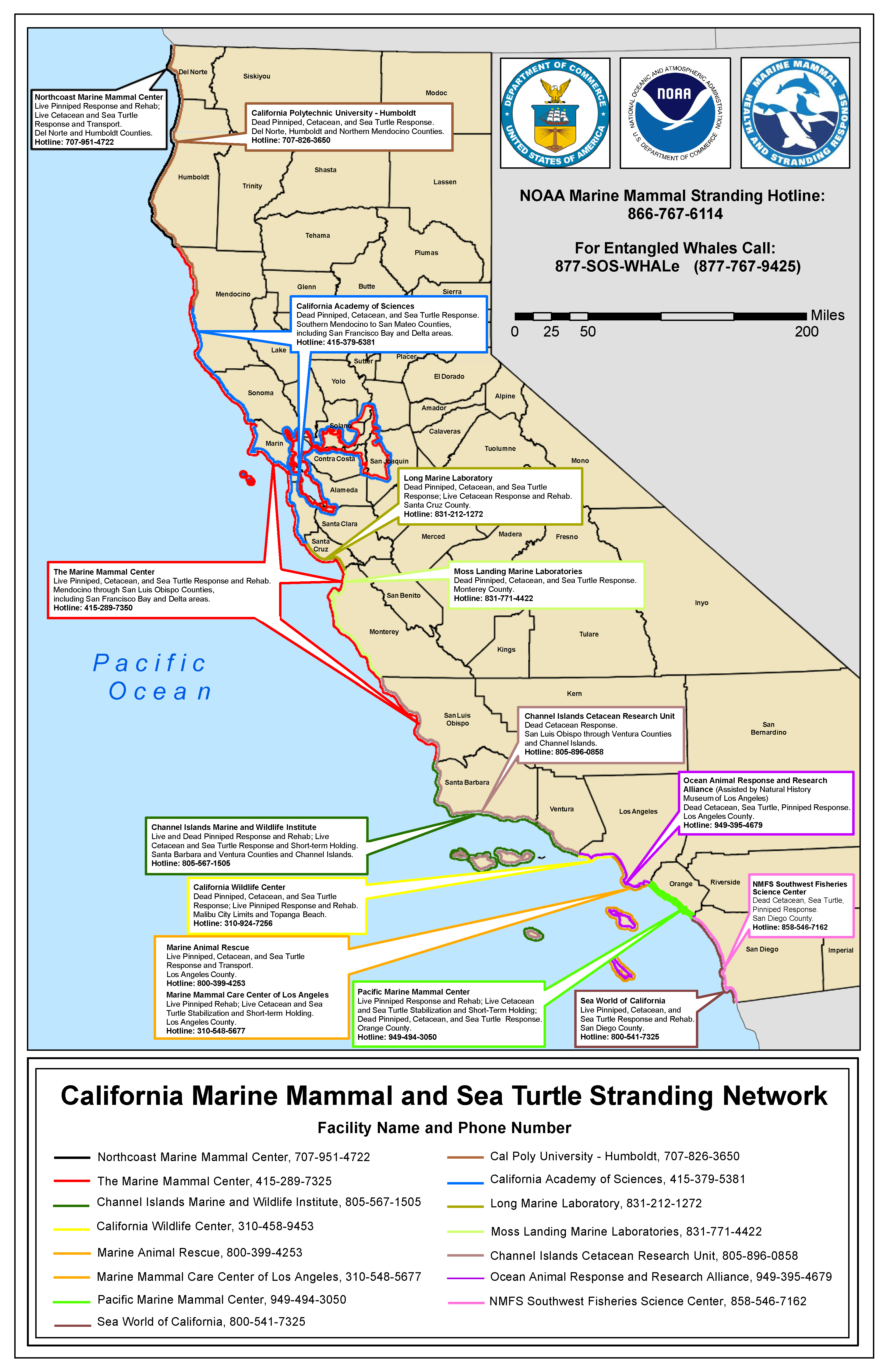
The Marine Mammal Center (TMMC), Channel Islands Marine Wildlife Institute (CIMWI), California Wildlife Center (CWC), Marine Mammal Care Center Los Angeles (MMCC-LA), Pacific Marine Mammal Center (PMMC), SeaWorld, and Southwest Fisheries Science Center (SWFSC) act like an emergency room by working to rescue and rehabilitate sick and injured marine mammals, seabirds, and sea turtles.
California's Marine Mammal Stranding Network Map
California HAB Bulletin
All data and reports have been synthesized by SCCOOS for the California Harmful Algal Bloom Monthly Bulletin.
Data Access & Resources:
C-HARM, NOAA CoastWatch ERDDAP
Toxic Phytoplankton Observations, CDPH
Imaging FlowCytoBot Dashboard
CalHABMAP Datasets, SCCOOS ERDDAP