
 info@sccoos.org
May-June, 2026
Summary written by Dr. Kasia Kenitz & Dr. Clarissa Anderson on August 19, 2026
- SUMMARY: May and June 2026 were marked by increased Pseudo-nitzschia activity in Central California, consistent with C-HARM predictions of high probabilities of Pseudo-nitzschia abundance and domoic acid (DA) concentrations exceeding alert thresholds in that region. Cal Poly Pier and Santa Cruz Wharf emerged as the two regional hotspots, with the smaller, less toxigenic “delicatissima” group at Cal Poly Pier reaching 2,658,986 cells/L on 5/10 and the larger, more toxigenic “seriata” group at Santa Cruz Wharf surging to 2,245,440 cells/L on 5/27, coinciding with the most elevated pDA detections of the period: 5,632 ng/L on 5/20 and 11,192 ng/L on 5/27. Southern California stations recorded elevated but comparatively modest Pseudo-nitzschia activity through much of May before activity declined at most sites through June. Stearns Wharf recorded a particularly intense early May peak of 120,000-140,000 images/L (approximately 240,000-420,000 cells/L) by IFCB. IFCB data broadly corroborated HABMAP observations across the period and provided an important window into Northern California activity at Trinidad Pier, where Pseudo-nitzschia was detected at bloom levels in mid-June, consistent with C-HARM predictions for that region. Elevated levels of DA detected in commercially harvested Pacific sardines and Northern anchovies from Central California waters in mid-June prompted state health agencies to recommend commercial fisheries restrictions implemented by CDFW, and CDPH to issue a consumption advisory for the recreational fisheries on 6/26. A total of 19 marine mammal strandings with suspected DA exposure were reported across May and June, with Central California accounting for the majority of cases. Two humpback whales stranded on Monterey Bay beaches during this period, with very high DA levels detected in biological samples (see press release: https://news.ucsc.edu/2026/06/dead-whales-domoic-acid/). Alexandrium remained largely rare or undetected statewide, with low but persistent detections at Cal Poly Pier through May and June.
IMPORTANT NOTE: Pseudo-nitzschia activity continues to persist along the Central and Northern California coast. Trinidad Pier has recorded bloom-level Pseudo-nitzschia throughout August 10-17. Elevated DA was detected at both Humboldt (500 ng/L total DA, 5.5 ppm DA in mussels) and Santa Cruz (26,700 ng/L dissolved DA, 150 ng/L pDA, 2.03 ppm DA in mussels), with mussel DA at both sites trending upward though currently below the 20 ppm CDPH alert level. On 7/31, the Del Norte razor clam recreational fishery was closed while the central California commercial sardine and anchovy fishery restrictions and recreational fishery advisory were lifted. Monterey Wharf recorded Pseudo-nitzschia at abundant levels on 8/12. Offshore, recent WCOA cruise observations confirmed high Pseudo-nitzschia between Point Conception and Monterey in July and August. Southern California sites are currently showing low Pseudo-nitzschia activity, with the HAB community dominated by dinoflagellates.
* Pseudo-nitzschia alert threshold: 10,000 cells/L. Particulate domoic acid (pDA) alert threshold: 500 ng/L.
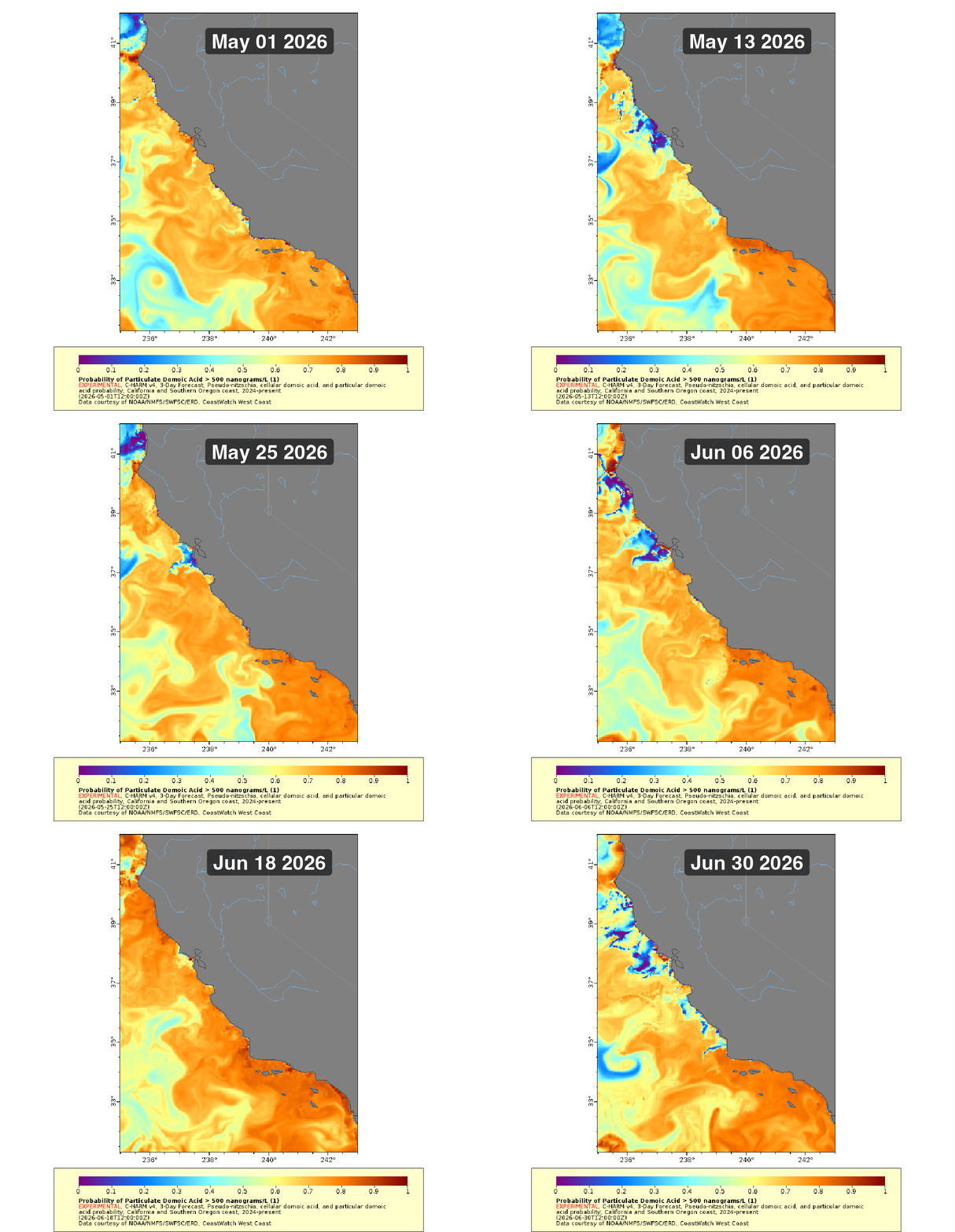
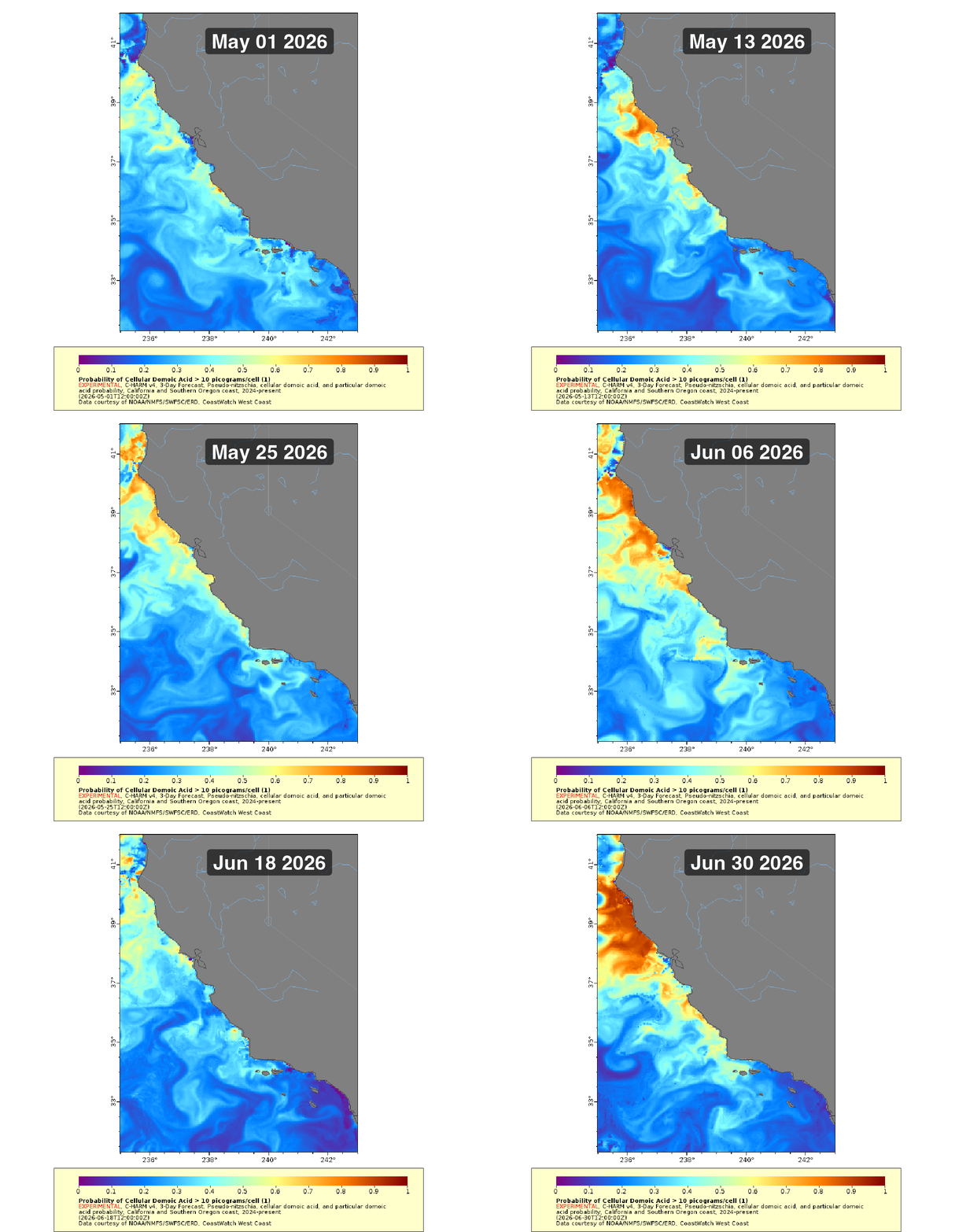
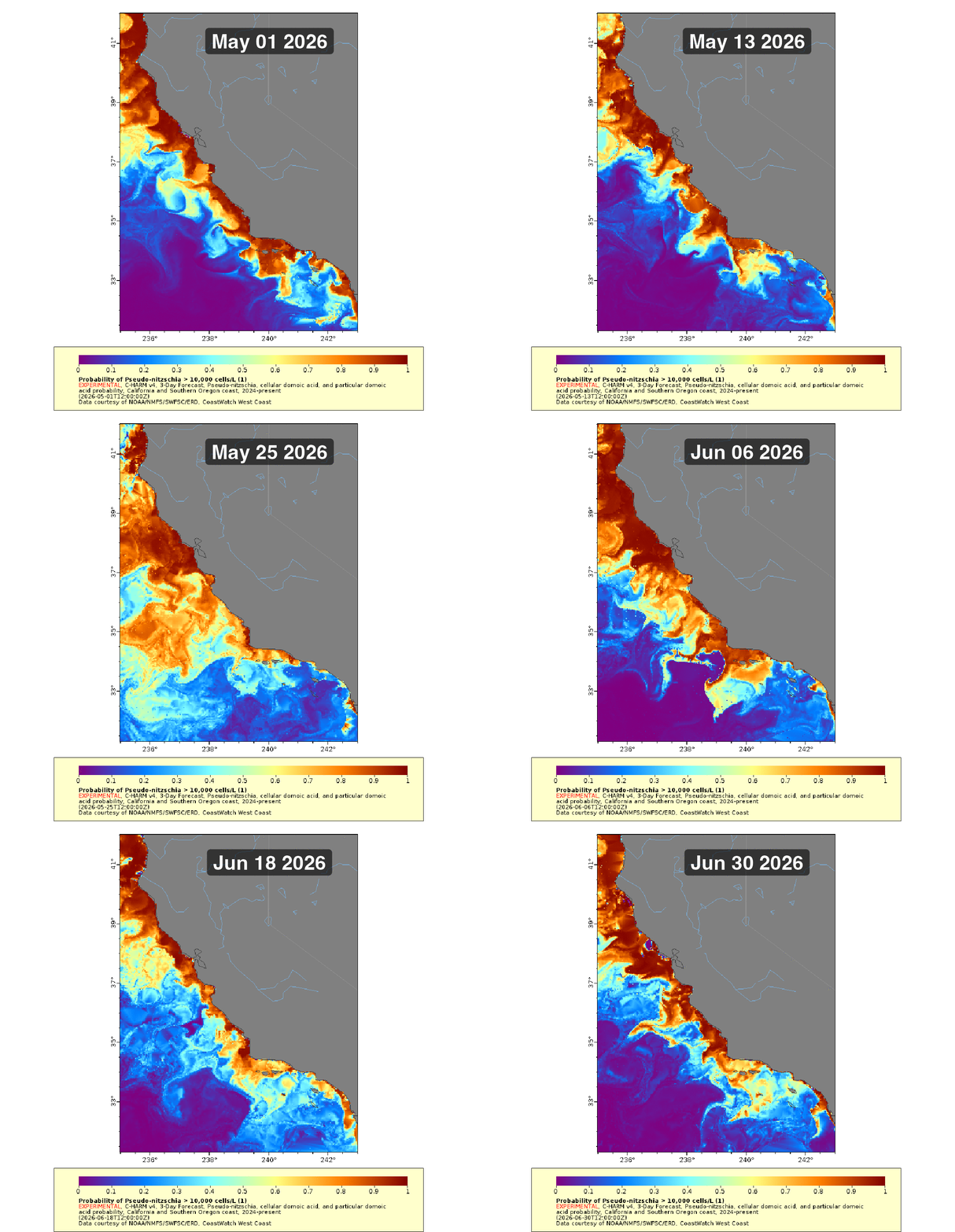
- C-HARM predicted low probabilities of Pseudo-nitzschia exceeding alert thresholds across much of the Southern California Bight through May and June, with occasional coastal hotspots but persistently low offshore risk. In contrast, the Channel Islands and much of Central and Northern California showed very high probabilities for Pseudo-nitzschia abundance along both the coast and offshore throughout the period. In June, probability of high Pseudo-nitzschia abundance briefly subsided in Central California mid-month before returning strongly in the second half of June. High cellular domoic acid (cDA) probabilities remained low along the Southern California coast and offshore through both months, while risk increased in Central California from mid-May. This trend extended into Northern California through the first half of June, dropping briefly mid-month before rising again by the end of June in Northern California. Particulate domoic acid (pDA) probabilities remained high across much of California through May and June, with only occasional short-lived reductions along the Central and Northern California coast through the first half of June. By the second half of June, high pDA probabilities were widespread across all California waters, both nearshore and offshore.
- Weekly HABMAP sampling of phytoplankton showed that May was a period of more intense Pseudo-nitzschia activity at HABMAP stations from the Channel Islands to Central California, consistent with C-HARM predictions of very high risk across that region. The most striking abundances were recorded at Cal Poly Pier and Santa Cruz Wharf, which emerged as the two regional hotspots of activity. Cal Poly Pier recorded exceptional abundances of the less toxigenic “delicatissima” group, reaching 2,052,345 cells/L on 5/3, and climbing further to 2,658,986 cells/L on 5/10. Concentrations dropped sharply in the second half of May before surging again to 1,029,371 cells/L on 6/7. The more toxigenic “seriata” group at Cal Poly Pier reached 234,020 cells/L on 5/3, peaking at 587,983 cells/L on 5/10, before declining and remaining below alert thresholds for the remainder of May and June. Elevated pDA confirmed active toxin production during both peaks, reaching 367 ng/L on 5/3 and 572 ng/L on 6/7. Santa Cruz Wharf recorded the most elevated toxin levels of the period. The “seriata” group reached 636,555 cells/L on 5/20, surging to 2,245,440 cells/L on 5/27, coinciding with pDA of 5,632 ng/L on 5/20 and 11,192 ng/L on 5/27, far exceeding the alert threshold and reflecting intense toxin production during this bloom. (Note: Santa Cruz Wharf is not currently reporting “delicatissima” group abundances.)
Elsewhere, Southern California stations recorded elevated Pseudo-nitzschia through much of May and into June, broadly consistent with the low to occasionally elevated risk predicted by C-HARM for the Southern California Bight. In early May, “delicatissima” group abundances were detected at Scripps Pier (17,522 cells/L), Santa Monica Pier (14,960 cells/L), and Stearns Wharf (15,340 cells/L) on 5/4 with a secondary increase at Scripps Pier and Newport Pier in mid-May. Santa Monica Pier carried elevated “seriata” levels from late April into early May, peaking at 77,792 cells/L with pDA of 1,692 ng/L on 5/4. Scripps Pier remained the most persistently elevated Southern California station through June, reaching 55,071 cells/L by 6/29, and Newport Pier recorded above-alert “seriata” concentrations of 38,982 cells/L on 6/15.
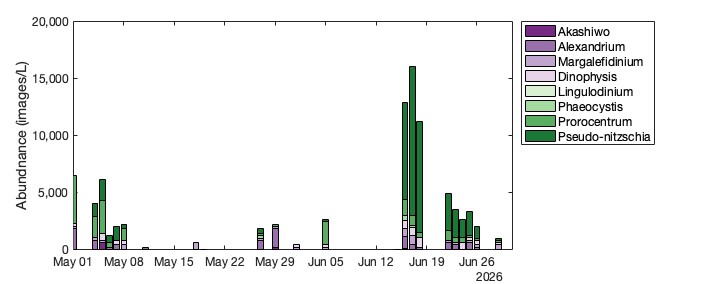
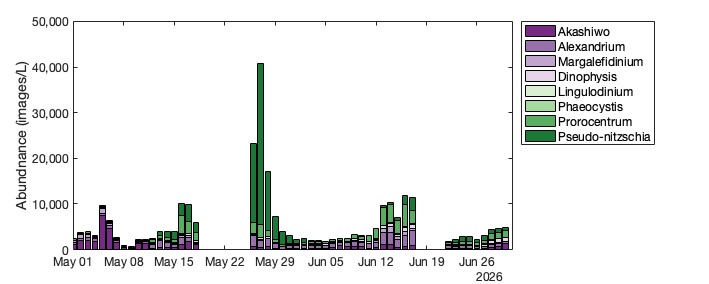
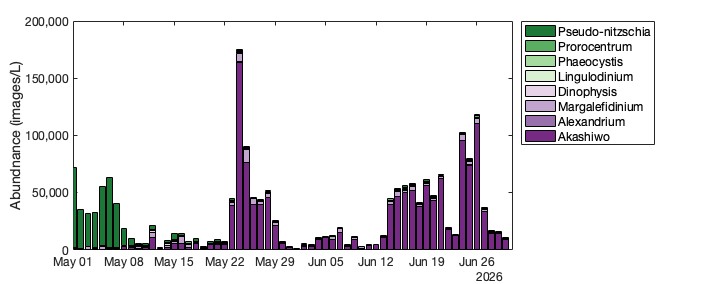
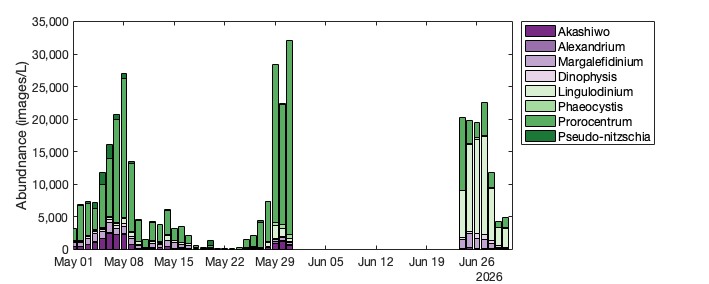
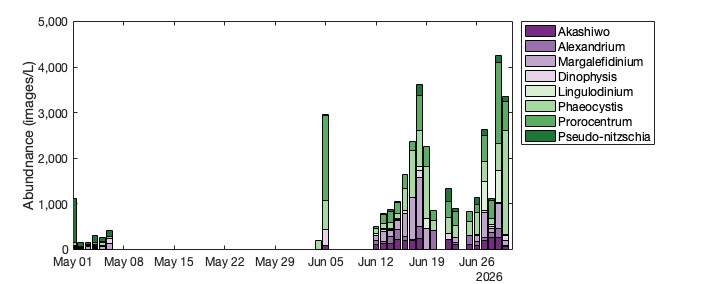
Alexandrium remained largely rare or undetected across most HABMAP sites, with the exception of Cal Poly Pier, where concentrations reached 2,132 cells/L on 5/24 and increased to 3,731 cells/L on 6/14. - The data collected by Imaging Flow Cytobots (IFCBs) – robotic microscopes – broadly corroborate HABMAP observations, and provide additional coverage in Northern California where HABMAP monitoring is limited. Santa Cruz Wharf recorded the most intense Central California signal, with Pseudo-nitzschia reaching up to 70,000 images/L (approximately 140,000-210,000 cells/L) by the end of May, consistent with the exceptional HABMAP abundances recorded at that station in late May. In Northern California, Trinidad Pier – where sample collection is thus far done manually with increased sampling frequency when Pseudo-nitzschia is detected – recorded Pseudo-nitzschia at 10,000-14,000 images/L (approximately 20,000-42,000 cells/L) between June 15-18, with abundances declining through the end of the month, consistent with C-HARM predictions of elevated risk in that region. Among Southern California stations, Stearns Wharf recorded the most striking signal, with Pseudo-nitzschia reaching 120,000-140,000 images/L (approximately 240,000-420,000 cells/L) in early May, consistent with elevated HABMAP counts at that station, before declining by 5/10 and remaining low through the end of June. At Scripps Pier, Del Mar mooring, and Newport Beach Pier, Pseudo-nitzschia was detected at 3,000-5,000 images/L (approximately 6,000-15,000 cells/L) in early May, with no further detections at Scripps Pier and Del Mar through the rest of the period. Newport Beach Pier recorded a brief secondary increase of similar magnitude in mid-May. The HAB community across Southern California sites was dominated by Prorocentrum, Akashiwo, and Margalefidinium through May and June, with an Akashiwo bloom dominating at Stearns Wharf through much of the period and Lingulodinium polyedra appearing at Newport Beach Pier at the end of June.
- Marine Mammal Strandings associated with suspected DA exposure totaled 19 cases across May and June. Central California accounted for the majority, with Monterey County recording the highest number (8), followed by San Luis Obispo County (4), Santa Cruz County (2), and San Mateo County (1). Southern California recorded 4 cases (Los Angeles County: 1, Orange County: 3). Stranding numbers were slightly higher in May (11 cases) than in June (8 cases), broadly consistent with the intense Pseudo-nitzschia activity and elevated pDA levels recorded at Cal Poly Pier and Santa Cruz Wharf, elevated DA in sardines and anchovies from Central California in mid-June, and with C-HARM predictions of elevated DA risk in that region. Following the exceptionally high pDA levels recorded at Santa Cruz Wharf on 5/27 (11,192 ng/L), two humpback whales stranded in Monterey County and Santa Cruz County, respectively, with high DA levels detected in biological samples (see press release: https://news.ucsc.edu/2026/06/dead-whales-domoic-acid/).
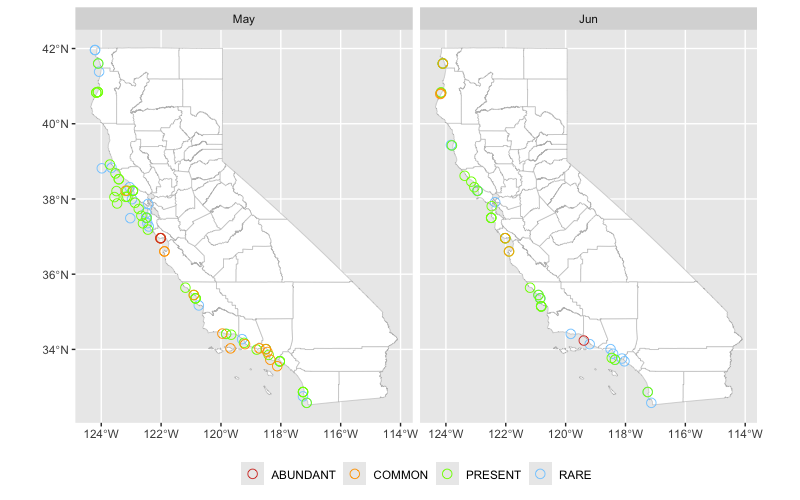
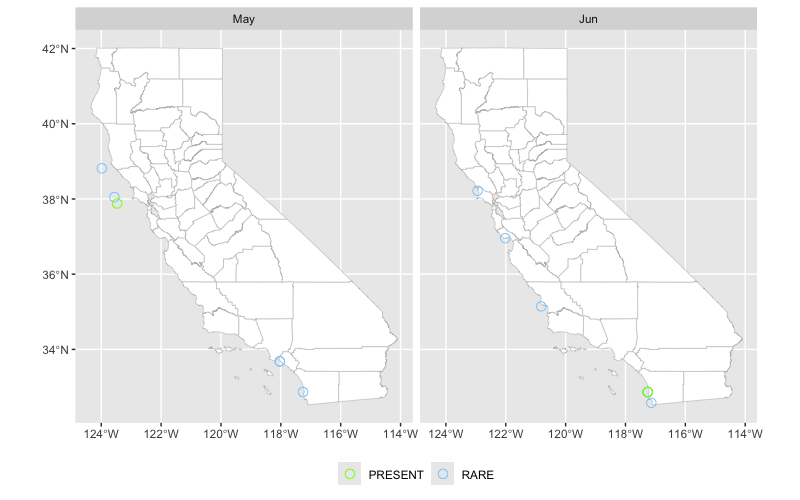
- California Department of Public Health (CDPH) Environmental Management Branch (EMB) conducts its own phytoplankton monitoring and molluscan bivalve shellfish testing for PSP toxins and DA. CDPH phytoplankton monitoring detected Pseudo-nitzschia at “present” to “common” levels across much of the California coast in May, with “abundant” levels reported in Santa Cruz County, consistent with the exceptional Pseudo-nitzschia abundances recorded at Santa Cruz Wharf by HABMAP during that period. In June, Central California sites remained at “present” to “common” levels while Southern California sites declined to mostly “rare” levels. Alexandrium was largely rare through much of May and June, detected at “present” levels only in Marin County in May and San Diego County in June. During May and June, several recreational bivalve advisories from the previous period were lifted: Marin County on 5/21, San Mateo County on 5/26, and Sonoma County on 6/11. Office of Environmental Health Hazard Assessment (OEHHA), CDPH Food and Drug Branch (FDB), and California Department of Fish and Wildlife (CDFW) coordinate sample collection, analysis, and potential fishery actions for marine biotoxins in crustaceans and finfish. Elevated levels of DA detected in commercially harvested Pacific sardines and Northern anchovies from Central California waters in mid-June prompted state health agencies to recommend commercial fisheries restrictions implemented by CDFW, and CDPH to issue a consumption advisory for the recreational fisheries on 6/26. The elevated DA in finfish was consistent with the elevated pDA levels recorded at Santa Cruz Wharf during this period.
** Currently, CDPH is advising consumers not to eat sport-harvested razor clams from Del Norte County due to dangerous levels of domoic acid detected in shellfish from those waters. The advisory previously in effect for sport-harvested bivalve shellfish from Del Norte County was lifted on 7/14. The restriction implemented by CDFW on 6/26 for commercially harvested Pacific sardines and Northern anchovies from Central California waters was lifted on 7/31. The annual statewide mussel quarantine for sport-harvested mussels along the entire California coast remains in effect through October 31, 2026.
For current bivalve shellfish advisories please see CDPH advisory map.For current health advisories and closures for finfish, shellfish, and crustaceans, please see Health Advisories and Closures for California Finfish, Shellfish and Crustaceans.
- SUMMARY: May and June 2026 were marked by increased Pseudo-nitzschia activity in Central California, consistent with C-HARM predictions of high probabilities of Pseudo-nitzschia abundance and domoic acid (DA) concentrations exceeding alert thresholds in that region. Cal Poly Pier and Santa Cruz Wharf emerged as the two regional hotspots, with the smaller, less toxigenic “delicatissima” group at Cal Poly Pier reaching 2,658,986 cells/L on 5/10 and the larger, more toxigenic “seriata” group at Santa Cruz Wharf surging to 2,245,440 cells/L on 5/27, coinciding with the most elevated pDA detections of the period: 5,632 ng/L on 5/20 and 11,192 ng/L on 5/27. Southern California stations recorded elevated but comparatively modest Pseudo-nitzschia activity through much of May before activity declined at most sites through June. Stearns Wharf recorded a particularly intense early May peak of 120,000-140,000 images/L (approximately 240,000-420,000 cells/L) by IFCB. IFCB data broadly corroborated HABMAP observations across the period and provided an important window into Northern California activity at Trinidad Pier, where Pseudo-nitzschia was detected at bloom levels in mid-June, consistent with C-HARM predictions for that region. Elevated levels of DA detected in commercially harvested Pacific sardines and Northern anchovies from Central California waters in mid-June prompted state health agencies to recommend commercial fisheries restrictions implemented by CDFW, and CDPH to issue a consumption advisory for the recreational fisheries on 6/26. A total of 19 marine mammal strandings with suspected DA exposure were reported across May and June, with Central California accounting for the majority of cases. Two humpback whales stranded on Monterey Bay beaches during this period, with very high DA levels detected in biological samples (see press release: https://news.ucsc.edu/2026/06/dead-whales-domoic-acid/). Alexandrium remained largely rare or undetected statewide, with low but persistent detections at Cal Poly Pier through May and June.
Particulate Domoic Acid
Particulate domoic acid (pDA) is the measurement of total domoic acid toxin that is potentially extant in a given area. This forecast provides a probability for where that concentration of toxin is predicted to exceed the threshold that classifies a Harmful Algal Bloom (> 500 nanograms per Liter).
The C-HARM v4 model generates nowcast and forecasts of the probability of Pseudo-nitzschia concentrations of in excess of 10,000 cells/L, the probability of particulate domoic acid > 500 nanograms/L, and the probability of cellular domoic acid > 10 picograms/cell in California and Southern Oregon coastal waters. Inputs for the model include near real-time satellite observations, gap-filled chlorophyll a, 486nm reflectance, and 551nm reflectance fields from the S-NPP NOAA VIIRS sensor plus nowcast and forecast data of surface salinity, sea surface temperature, and surface currents from WCOFS ROMS.
Cellular Domoic Acid
Cellular domoic acid (cDA) is the measure of total domoic acid toxin calculated per cell of Pseudo-nitzschia. This forecast provides a probability for where those cells are expected to be producing toxin at high levels (> 10 picograms per cell).
The C-HARM v4 model generates nowcast and forecasts of the probability of Pseudo-nitzschia concentrations of in excess of 10,000 cells/L, the probability of particulate domoic acid > 500 nanograms/L, and the probability of cellular domoic acid > 10 picograms/cell in California and Southern Oregon coastal waters. Inputs for the model include near real-time satellite observations, gap-filled chlorophyll a, 486nm reflectance, and 551nm reflectance fields from the S-NPP NOAA VIIRS sensor plus nowcast and forecast data of surface salinity, sea surface temperature, and surface currents from WCOFS ROMS.
Pseudo-nitzschia
Pseudo-nitzschia is a neurotoxin producing diatom that is observed along the California Coast. Blooms of this phytoplankton can be detrimental to surrounding marine ecosystems. This forecast provides a probability for where the concentration of cells in the water exceed the threshold of a Harmful Algal Bloom ( > 10,000 cells/L).
The C-HARM v4 model generates nowcast and forecasts of the probability of Pseudo-nitzschia concentrations of in excess of 10,000 cells/L, the probability of particulate domoic acid > 500 nanograms/L, and the probability of cellular domoic acid > 10 picograms/cell in California and Southern Oregon coastal waters. Inputs for the model include near real-time satellite observations, gap-filled chlorophyll a, 486nm reflectance, and 551nm reflectance fields from the S-NPP NOAA VIIRS sensor plus nowcast and forecast data of surface salinity, sea surface temperature, and surface currents from WCOFS ROMS.
California Harmful Algal Bloom Monitoring & Alert Program
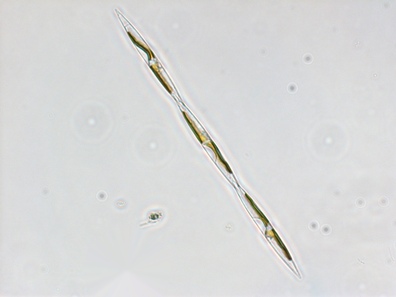
Differentiating Pseudo-nitzschia species by light microscopy is difficult. For this reason, Pseudo-nitzschia “seriata” does not refer to an actual species but rather the larger size class of Pseudo-nitzschia, which is generally a more toxigenic group of species. Alternatively, Pseudo-nitzschia “delicatissima” refers to the smaller size class that is generally non-toxigenic. The dashed line on the plots demarcates the 10,000 cells/L “bloom” threshold designated here for Pseudo-nitzschia populations only.
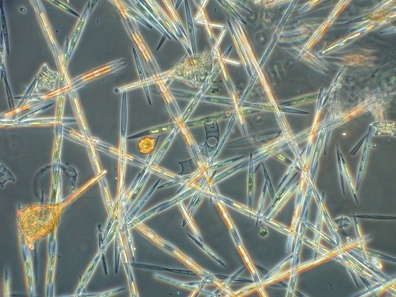
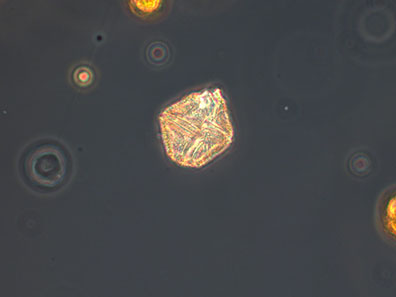
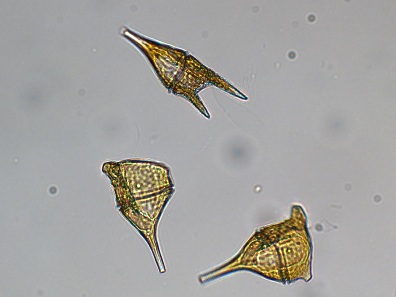
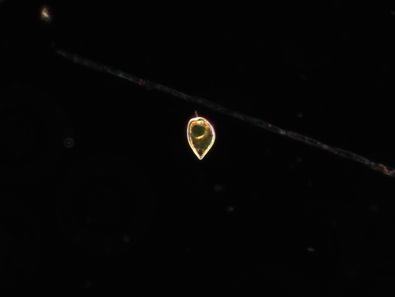
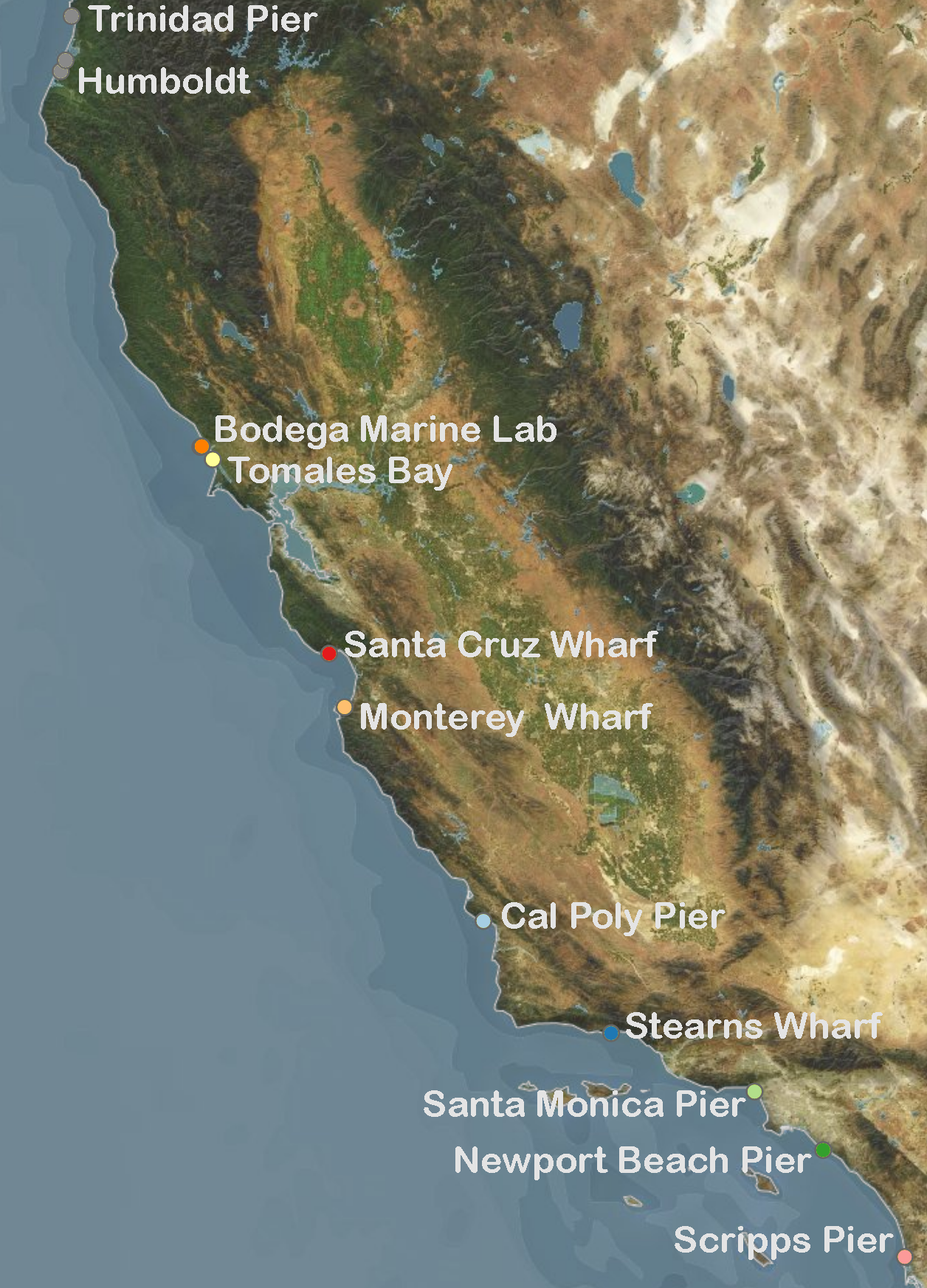
Data for some stations are not shown as they are not yet recorded in the public HABMAP archive.
These time series focus on data collected through the scope of this bulletin and the 12 month period that precedes it. Explore the variables and regions that make up the CalHABMAP collective dataset using the plot controls.
More information and data visualizations on the statewide HAB network and forecasting system is found on the California HABMAP website and on the SCCOOS Harmful Algal Bloom page.
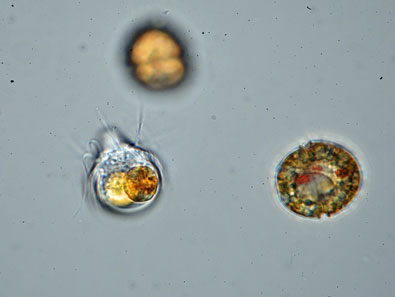
A network of Imaging FlowCytobots (IFCBs) continuously photographs particles, such as plankton, in the water. Using machine learning, plankton species can be automatically identified. This will help improve the ability to detect and respond to Harmful Algal Blooms, including the ability to assess conditions that may lead to toxin production or blooms of toxin-producing algae.
These data, coupled with the image classification algorithms developed in collaboration with SCCOOS and CeNCOOS, allow for estimates of species composition over time. The time series below depict sampling outcomes across several California sites. Support provided by NOAA IOOS and CA OPC.
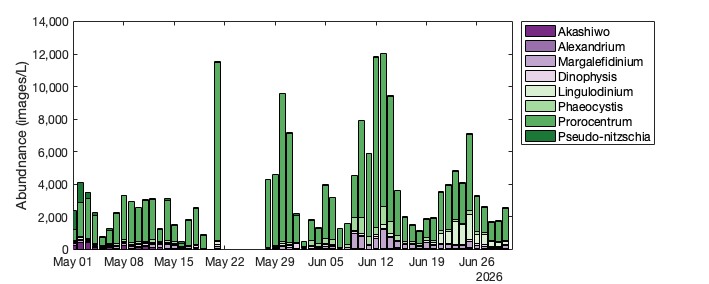
Additional images and data are available on the IFCB dashboard.
Each month, water samples are collected by volunteers and sent to the California Department of Public Health (CDPH) for analysis. The relative abundance of DA-producing Pseudo-nitzschia ‘seriata’ size class (upper) and PSP toxin-producing Alexandrium spp. (lower) are catalogued from sample locations within each county.
____
CDPH is advising the public not to eat sport-harvested mussels, clams, scallops or oysters gathered from Del Norte County due to dangerous levels of paralytic shellfish poisoning toxins.
____
CDPH has removed the warning that advised against eating sport-harvested bivalve shellfish from the waters of Marin County.
____
CDPH has removed the warning that advised against eating recreationally harvested bivalve shellfish from the waters of San Mateo County.
____
CDPH has removed the warning that advised against eating recreationally harvested bivalve shellfish from the waters of Sonoma County.
____
Dangerous levels of domoic acid have been detected in sardines and anchovies collected from Central California Coastal waters. The public is advised to not consume commercially harvested Pacific sardines and Northern anchovies from the affected area until further notice.
Percent composition categories help us look at phytoplankton trends across an entire region to evaluate risk of biotoxin presence. Many other factors contribute to our evaluation of risk in an area. These samples are posted for informational purposes only. They are not intended to inform the public of the presence or lack of risk. For the latest health advisory information, see the CDPH Health Advisory Map below.
Water Sample Detailed Data
| Sample_ID | Date_Sampled | Sample_Site | Latitude | Longitude | PN_Percent_Comp | PN_Density | AL_Percent_Comp | AL_Density |
|---|---|---|---|---|---|---|---|---|
| UB-6695-01 | 5/3/26 | Pillar Point Harbor | 37.49883 | -122.48753 | 0.5 | RARE | ||
| UB-6698-01 | 5/4/26 | Humboldt Bay, Bird Island | 40.844 | -124.1137 | 2 | PRESENT | ||
| UB-6699-01 | 5/4/26 | Morro Bay, Boat Launch | 35.357025 | -120.85021 | 4 | PRESENT | ||
| UB-6710-01 | 5/4/26 | Tomales Bay, Lease #M430-15 | 38.2176 | -122.9437 | 5 | PRESENT | ||
| UB-6719-01 | 5/4/26 | La Jolla, Scripps Pier | 32.867156 | -117.257594 | 3 | PRESENT | ||
| UB-6720-01 | 5/3/26 | Cayucos Pier | 35.446474 | -120.907749 | 20 | COMMON | ||
| UB-6721-01 | 5/5/26 | Wilson Creek | 41.601596 | -124.102324 | 1 | PRESENT | ||
| UB-6723-01 | 5/11/26 | Drakes Bay, Chimney Rock LBS | 37.994808 | -122.973274 | 0.5 | RARE | ||
| UB-6724-01 | 5/11/26 | Humboldt Bay, Bird Island | 40.844 | -124.1137 | 1 | PRESENT | ||
| UB-6725-01 | 5/11/26 | Morro Bay, Boat Launch | 35.357025 | -120.85021 | 3 | PRESENT | ||
| UB-6726-01 | 5/11/26 | Tomales Bay, Lease #M430-15 | 38.2176 | -122.9437 | 3 | PRESENT | ||
| UB-6734-01 | 5/6/26 | Santa Cruz Wharf | 36.957391 | -122.017638 | 15 | COMMON | ||
| UB-6735-01 | 5/6/26 | Ventura, Port Hueneme Pier | 34.139234 | -119.19586 | 20 | COMMON | ||
| UB-6736-01 | 5/7/26 | Santa Monica Pier | 34.0072 | -118.4985 | 6 | PRESENT | ||
| UB-6737-01 | 5/18/26 | Humboldt Bay, MR Ch Raft S | 40.827556 | -124.165417 | 7 | PRESENT | ||
| UB-6738-01 | 5/10/26 | Santa Cruz Wharf | 36.957391 | -122.017638 | 15 | COMMON | ||
| UB-6739-01 | 5/10/26 | Santa Catalina Ch., Plt Eureka | 33.554167 | -118.120833 | 40 | COMMON | ||
| UB-6742-01 | 5/13/26 | Goleta Pier | 34.412869 | -119.828141 | 0.5 | RARE | ||
| UB-6743-01 | 5/19/26 | Pescadero State Beach | 37.267295 | -122.411721 | 0.5 | RARE | ||
| UB-6744-01 | 5/11/26 | Hunter Rock, north | 41.959707 | -124.2079 | 0.5 | RARE | ||
| UB-6746-01 | 5/12/26 | Monterey Bay, Commercial Wharf | 36.605724 | -121.889411 | 10 | COMMON | ||
| UB-6748-01 | 5/11/26 | Wilson Creek | 41.601596 | -124.102324 | 0.5 | RARE | ||
| UB-6749-01 | 5/7/26 | San Francisco Bay, Angel Is N | 37.86746432 | -122.43664 | 0.5 | RARE | ||
| UB-6750-01 | 5/18/26 | Morro Bay, Boat Launch | 35.357025 | -120.85021 | 0.5 | RARE | ||
| UB-6751-01 | 5/21/26 | Bodega Harbor, USCG Dock | 38.3127654 | -123.051303 | 0.5 | RARE | ||
| UB-6752-01 | 5/18/26 | Tomales Bay, Lease #M430-15 | 38.2176 | -122.9437 | 0.5 | RARE | ||
| UB-6753-02 | 5/7/26 | Pillar Point Harbor | 37.49883 | -122.48753 | 0.5 | RARE | ||
| UB-6755-01 | 5/16/26 | Pillar Point Harbor | 37.49883 | -122.48753 | 0.5 | RARE | ||
| UB-6756-01 | 5/12/26 | GFNMS, Marin Line 2E | 38.056744 | -123.182798 | 3 | PRESENT | ||
| UB-6757-01 | 5/9/26 | GFNMS, Sonoma Line 15-E | 38.525778 | -123.413532 | 5 | PRESENT | ||
| UB-6758-01 | 5/4/26 | GFNMS, San Francisco Line 6E | 37.73425 | -122.7478 | 7 | PRESENT | ||
| UB-6759-01 | 5/8/26 | Bolsa Chica | 33.683442 | -118.034944 | 1 | PRESENT | ||
| UB-6760-01 | 5/7/26 | GFNMS, Mendocino Line 19E | 38.830633 | -123.657017 | 0.5 | RARE | ||
| UB-6761-01 | 5/9/26 | GFNMS, Sonoma Line 15-E | 38.525778 | -123.413532 | 5 | PRESENT | ||
| UB-6762-01 | 5/22/26 | San Diego, Ocean Beach, Off. | 32.751165 | -117.259613 | 0.5 | RARE | ||
| UB-6764-01 | 5/20/26 | Gold Bluffs Beach | 41.38269 | -124.0718 | 0.5 | RARE | ||
| UB-6766-01 | 5/12/26 | GFNMS, Marin Line 2W | 38.05 | -123.56 | 3 | PRESENT | 0.5 | RARE |
| UB-6767-01 | 5/11/26 | La Jolla, Scripps Pier | 32.867156 | -117.257594 | 1 | PRESENT | ||
| UB-6768-01 | 5/27/26 | Santa Cruz Wharf | 36.957391 | -122.017638 | 65 | ABUNDANT | ||
| UB-6769-01 | 6/1/26 | Tomales Bay, Lease #M430-15 | 38.2176 | -122.9437 | 5 | PRESENT | ||
| UB-6776-01 | 5/21/26 | Hunter Rock, north | 41.959707 | -124.2079 | 0.5 | RARE | ||
| UB-6778-01 | 5/26/26 | Humboldt Bay, MR Ch Raft S | 40.827556 | -124.165417 | 6 | PRESENT | ||
| UB-6779-01 | 5/21/26 | San Luis Obispo, Cal Poly Pier | 35.169492 | -120.740824 | 0.5 | RARE | ||
| UB-6780-01 | 5/26/26 | Tomales Bay, Lease #M430-15 | 38.2176 | -122.9437 | 5 | PRESENT | ||
| UB-6781-01 | 5/26/26 | Morro Bay, Boat Launch | 35.357025 | -120.85021 | 2 | PRESENT | ||
| UB-6782-01 | 5/27/26 | Goleta Pier | 34.412869 | -119.828141 | 4 | PRESENT | ||
| UB-6783-01 | 5/27/26 | Santa Barbara, Stearns Wharf | 34.390778 | -119.65926 | 5 | PRESENT | ||
| UB-6784-01 | 5/18/26 | La Jolla, Scripps Pier | 32.867156 | -117.257594 | 1 | PRESENT | 0.5 | RARE |
| UB-6785-01 | 5/12/26 | Santa Monica Bay, 3201 | 33.85416 | -118.40611 | 2 | PRESENT | ||
| UB-6786-01 | 5/13/26 | Santa Monica Pier | 34.0072 | -118.4985 | 20 | COMMON | ||
| UB-6787-01 | 5/13/26 | Santa Monica Bay, 3501 | 33.93138 | -118.44805 | 10 | COMMON | ||
| UB-6788-01 | 5/14/26 | Palos Verdes, OFFSHORE | 33.72522 | -118.35175 | 15 | COMMON | ||
| UB-6790-01 | 5/15/26 | Santa Barbara Ch., Naples Pt | 34.4204 | -119.953 | 10 | COMMON | ||
| UB-6795-01 | 5/20/26 | Imperial Beach Pier | 32.579615 | -117.137422 | 1 | PRESENT | ||
| UB-6796-01 | 5/27/26 | Santa Monica Pier | 34.0072 | -118.4985 | 0.5 | RARE | ||
| UB-6798-01 | 5/25/26 | Cayucos Pier | 35.446474 | -120.907749 | 3 | PRESENT | ||
| UB-6799-01 | 5/24/26 | Pillar Point Harbor | 37.49883 | -122.48753 | 0.5 | RARE | ||
| UB-6800-01 | 5/30/26 | Pillar Point Harbor | 37.49883 | -122.48753 | 3 | PRESENT | ||
| UB-6801-01 | 5/29/26 | Bolsa Chica | 33.683442 | -118.034944 | 1 | PRESENT | 0.5 | RARE |
| UB-6802-01 | 5/14/26 | Bolsa Chica | 33.683442 | -118.034944 | 1 | PRESENT | 0.5 | RARE |
| UB-6803-01 | 5/17/26 | Pacifica Pier | 37.633511 | -122.498106 | 0.5 | RARE | ||
| UB-6804-01 | 5/20/26 | Santa Cruz Wharf | 36.957391 | -122.017638 | 45 | COMMON | ||
| UB-6805-01 | 5/22/26 | Ventura Pier | 34.272084 | -119.292754 | 0.5 | RARE | ||
| UB-6807-01 | 5/28/26 | San Simeon Pier | 35.640776 | -121.188032 | 2 | PRESENT | ||
| UB-6808-01 | 5/14/26 | Santa Monica Bay, 3901 | 34.027717 | -118.71666 | 20 | COMMON | ||
| UB-6809-01 | 5/5/26 | Ventura, Channel Is. Harbor | 34.173779 | -119.229128 | 1 | PRESENT | ||
| UB-6810-01 | 6/3/26 | Santa Cruz Wharf | 36.957391 | -122.017638 | 20 | COMMON | ||
| UB-6811-01 | 5/1/26 | Bolsa Chica | 33.683442 | -118.034944 | 0.5 | RARE | ||
| UB-6814-01 | 6/7/26 | Pillar Point Harbor | 37.49883 | -122.48753 | 1 | PRESENT | ||
| UB-6815-01 | 6/4/26 | Bodega Harbor, USCG Dock | 38.3127654 | -123.051303 | 1 | PRESENT | ||
| UB-6816-01 | 6/4/26 | Jenner, Russian Gulch Beach | 38.460422 | -123.151906 | 3 | PRESENT | ||
| UB-6817-01 | 6/8/26 | Tomales Bay, Lease #M430-15 | 38.2176 | -122.9437 | 0.5 | RARE | ||
| UB-6818-01 | 6/8/26 | Morro Bay, Boat Launch | 35.357025 | -120.85021 | 1 | PRESENT | ||
| UB-6820-01 | 5/27/26 | Imperial Beach Pier | 32.579615 | -117.137422 | 0.5 | RARE | ||
| UB-6822-01 | 5/30/26 | Santa Cruz Is., Prisoners Hrbr | 34.0269 | -119.6811 | 15 | COMMON | ||
| UB-6823-01 | 6/3/26 | Ventura, Offshore Station 3 | 34.235567 | -119.392203 | 50 | ABUNDANT | ||
| UB-6824-01 | 5/26/26 | Point Arena Pier | 38.9147 | -123.711241 | 6 | PRESENT | ||
| UB-6825-01 | 6/2/26 | Palos Verdes, OFFSHORE | 33.72522 | -118.35175 | 5 | PRESENT | ||
| UB-6826-01 | 6/2/26 | Wilson Creek | 41.601596 | -124.102324 | 0.5 | RARE | ||
| UB-6828-01 | 5/13/26 | Santa Cruz Wharf | 36.957391 | -122.017638 | 57 | ABUNDANT | ||
| UB-6829-01 | 6/3/26 | Kashia Coastal Reserve | 38.616162 | -123.374748 | 2 | PRESENT | ||
| UB-6830-01 | 6/5/26 | Imperial Beach Pier | 32.579615 | -117.137422 | 0.5 | RARE | ||
| UB-6832-01 | 6/1/26 | La Jolla, Scripps Pier | 32.867156 | -117.257594 | 3 | PRESENT | ||
| UB-6833-01 | 6/10/26 | Richmond, Marina Bay Harbor | 37.913863 | -122.354155 | 0.5 | RARE | ||
| UB-6834-01 | 5/2/26 | GFNMS, San Mateo Line 10E | 37.355726 | -122.459192 | 0.5 | RARE | ||
| UB-6835-01 | 5/11/26 | GFNMS, Marin Line N11-WN | 38.2197 | -123.1358 | 5 | PRESENT | ||
| UB-6837-01 | 5/5/26 | GFNMS, Marin Line N4-WN | 37.898 | -122.8721 | 3 | PRESENT | ||
| UB-6840-01 | 6/8/26 | Ventura, Port Hueneme Pier | 34.139234 | -119.19586 | 0.5 | RARE | ||
| UB-6841-01 | 6/10/26 | Wilson Creek | 41.601596 | -124.102324 | 2 | PRESENT | ||
| UB-6842-01 | 6/8/26 | Mendocino, Noyo Harbor | 39.424478 | -123.800797 | 0.5 | RARE | ||
| UB-6843-01 | 6/8/26 | Mendocino, Noyo OFFSHORE | 39.434664 | -123.832786 | 0.5 | RARE | ||
| UB-6844-01 | 6/10/26 | Cayucos Pier | 35.446474 | -120.907749 | 2 | PRESENT | ||
| UB-6845-01 | 6/17/26 | Humboldt Bay, Woodley Island | 40.807096 | -124.162364 | 20 | COMMON | ||
| UB-6846-01 | 6/17/26 | Humboldt Bay, Del Norte Pier | 40.790795 | -124.18722 | 10 | COMMON | ||
| UB-6848-01 | 5/10/26 | GFNMS, Marin Line N2WN | 38.058151 | -123.129438 | 5 | PRESENT | ||
| UB-6849-01 | 5/2/26 | Monterey Bay, Commercial Wharf | 36.605724 | -121.889411 | 15 | COMMON | ||
| UB-6850-01 | 5/30/26 | Point Dume, offshore | 33.995209 | -118.806008 | 6 | PRESENT | ||
| UB-6851-01 | 6/1/26 | Monterey Bay, Fishermans Wharf | 36.60576 | -121.892454 | 25 | COMMON | ||
| UB-6852-01 | 6/3/26 | Port San Luis, Diablo Cove | 35.14469 | -120.8166 | 8 | PRESENT | ||
| UB-6853-01 | 6/3/26 | Pillar Point Harbor | 37.49883 | -122.48753 | 5 | PRESENT | ||
| UB-6854-01 | 6/8/26 | La Jolla, Scripps Pier | 32.867156 | -117.257594 | 1.5 | PRESENT | ||
| UB-6857-01 | 6/13/26 | Pillar Point Harbor | 37.49883 | -122.48753 | 0.5 | RARE | ||
| UB-6858-01 | 6/15/26 | Humboldt Bay, MR Ch Raft N | 40.83064 | -124.16325 | 3 | PRESENT | ||
| UB-6859-01 | 6/15/26 | Morro Bay, Boat Launch | 35.357025 | -120.85021 | 0.5 | RARE | ||
| UB-6860-01 | 6/15/26 | Tomales Bay, Lease #M430-15 | 38.2176 | -122.9437 | 0.5 | RARE | ||
| UB-6861-01 | 5/24/26 | Pillar Point Harbor | 37.49883 | -122.48753 | 0.5 | RARE | ||
| UB-6863-01 | 6/7/26 | Palos Verdes, OFFSHORE | 33.72522 | -118.35175 | 0.5 | RARE | ||
| UB-6865-01 | 5/11/26 | GFNMS, Marin Line 11E | 38.21845 | -123.18162 | 10 | COMMON | ||
| UB-6866-01 | 5/11/26 | GFNMS, Marin Line 11-M | 38.20991 | -123.490188 | 3 | PRESENT | ||
| UB-6867-01 | 5/8/26 | GFNMS, Sonoma Line 17E | 38.679402 | -123.523948 | 4 | PRESENT | ||
| UB-6869-01 | 5/3/26 | GFNMS, San Mateo Line 23E | 37.18535 | -122.44185 | 2 | PRESENT | ||
| UB-6870-01 | 5/1/26 | GFNMS, San Mateo Line 8W | 37.49 | -123.03 | 0.5 | RARE | ||
| UB-6872-01 | 5/2/26 | GFNMS, San Mateo Line 10-EX | 37.35244 | -122.60591 | 2 | PRESENT | ||
| UB-6873-01 | 5/1/26 | GFNMS, San Mateo Line N8-WN | 37.552371 | -122.659708 | 1 | PRESENT | ||
| UB-6874-01 | 5/5/26 | GFNMS, Marin Line 4W | 37.88 | -123.47 | 4 | PRESENT | 3 | PRESENT |
| UB-6875-01 | 5/7/26 | GFNMS, Mendocino Line 19M | 38.81536 | -123.98133 | 0.5 | RARE | 0.5 | RARE |
| UB-6877-01 | 6/10/26 | Santa Cruz Wharf | 36.957391 | -122.017638 | 0.5 | RARE | 0.5 | RARE |
| UB-6878-01 | 6/8/26 | Manhattan Beach Pier | 33.8856 | -118.4137 | 0.5 | RARE | ||
| UB-6879-01 | 6/5/26 | San Simeon Pier | 35.640776 | -121.188032 | 3 | PRESENT | ||
| UB-6880-01 | 6/22/26 | Morro Bay, Boat Launch | 35.357025 | -120.85021 | 0.5 | RARE | ||
| UB-6881-01 | 6/22/26 | Tomales Bay, Lease #M430-15 | 38.2176 | -122.9437 | 0.5 | RARE | 0.5 | RARE |
| UB-6883-01 | 6/22/26 | Humboldt Bay, MR Ch Raft S | 40.827556 | -124.165417 | 0.5 | RARE | ||
| UB-6887-01 | 6/22/26 | Wilson Creek | 41.601596 | -124.102324 | 30 | COMMON | ||
| UB-6891-01 | 6/15/26 | La Jolla, Scripps Pier | 32.867156 | -117.257594 | 1 | PRESENT | ||
| UB-6892-01 | 6/28/26 | Pillar Point Harbor | 37.49883 | -122.48753 | 1 | PRESENT | ||
| UB-6893-01 | 6/29/26 | Humboldt Bay, MR Ch Raft S | 40.827556 | -124.165417 | 7 | PRESENT | ||
| UB-6901-01 | 6/24/26 | Santa Cruz Wharf | 36.957391 | -122.017638 | 2 | PRESENT | ||
| UB-6902-01 | 6/24/26 | Goleta Pier | 34.412869 | -119.828141 | 0.5 | RARE | ||
| UB-6903-01 | 6/22/26 | La Jolla, Scripps Pier | 32.867156 | -117.257594 | 0.5 | RARE | 0.5 | RARE |
| UB-6904-01 | 6/29/26 | La Jolla, Scripps Pier | 32.867156 | -117.257594 | 0.5 | RARE | ||
| UB-6905-01 | 6/16/26 | Monterey Bay, Commercial Wharf | 36.605724 | -121.889411 | 2 | PRESENT | ||
| UB-6906-01 | 6/19/26 | Imperial Beach Pier | 32.579615 | -117.137422 | 0.5 | RARE | ||
| UB-6907-01 | 6/17/26 | Mendocino, Noyo Harbor | 39.424478 | -123.800797 | 1 | PRESENT | ||
| UB-6908-01 | 6/20/26 | Palos Verdes Rocky Pt Offshore | 33.772577 | -118.458328 | 1 | PRESENT | ||
| UB-6909-01 | 6/17/26 | Alamitos Bay, 2nd St. Bridge | 33.756592 | -118.11643 | 0.5 | RARE | ||
| UB-6910-01 | 6/19/26 | Cayucos Pier | 35.446474 | -120.907749 | 0.5 | RARE | ||
| UB-6911-01 | 6/26/26 | Bolsa Chica | 33.683442 | -118.034944 | 0.5 | RARE | ||
| UB-6923-01 | 6/25/26 | Santa Monica Pier | 34.0072 | -118.4985 | 0.5 | RARE | ||
| UB-6926-01 | 6/30/26 | Wilson Creek | 41.601596 | -124.102324 | 0.5 | RARE | ||
| UB-6928-01 | 6/17/26 | Santa Cruz Wharf | 36.957391 | -122.017638 | 3 | PRESENT | ||
| UB-6929-01 | 6/14/26 | San Francisco, Presidio Pier | 37.809316 | -122.469865 | 5 | PRESENT | ||
| UB-6930-01 | 6/12/26 | Port San Luis, Diablo Cove | 35.14469 | -120.8166 | 9 | PRESENT | ||
| UB-6949-01 | 6/18/26 | Port San Luis, Diablo Cove | 35.14469 | -120.8166 | 0.5 | RARE | ||
| UB-6950-01 | 6/16/26 | Port San Luis, Diablo Cove | 35.14469 | -120.8166 | 1 | PRESENT | 0.5 | RARE |
| UB-6951-01 | 6/16/26 | Port San Luis, Diablo Cove | 35.14469 | -120.8166 | 0.5 | RARE | ||
| UB-6952-01 | 6/16/26 | Wilson Creek | 41.601596 | -124.102324 | 4 | PRESENT |
Domoic acid (DA) is a potent neurotoxin produced by some diatom species of the genus Pseudo-nitzschia. Species exposed to DA can result in seizures, epilepsy, cardiomyopathy, and death depending upon the ingested dose. DA toxicosis commonly occurs in California sea lions (Zalophus californianus), presumably due to a combination of foraging behavior and seasonal movements.
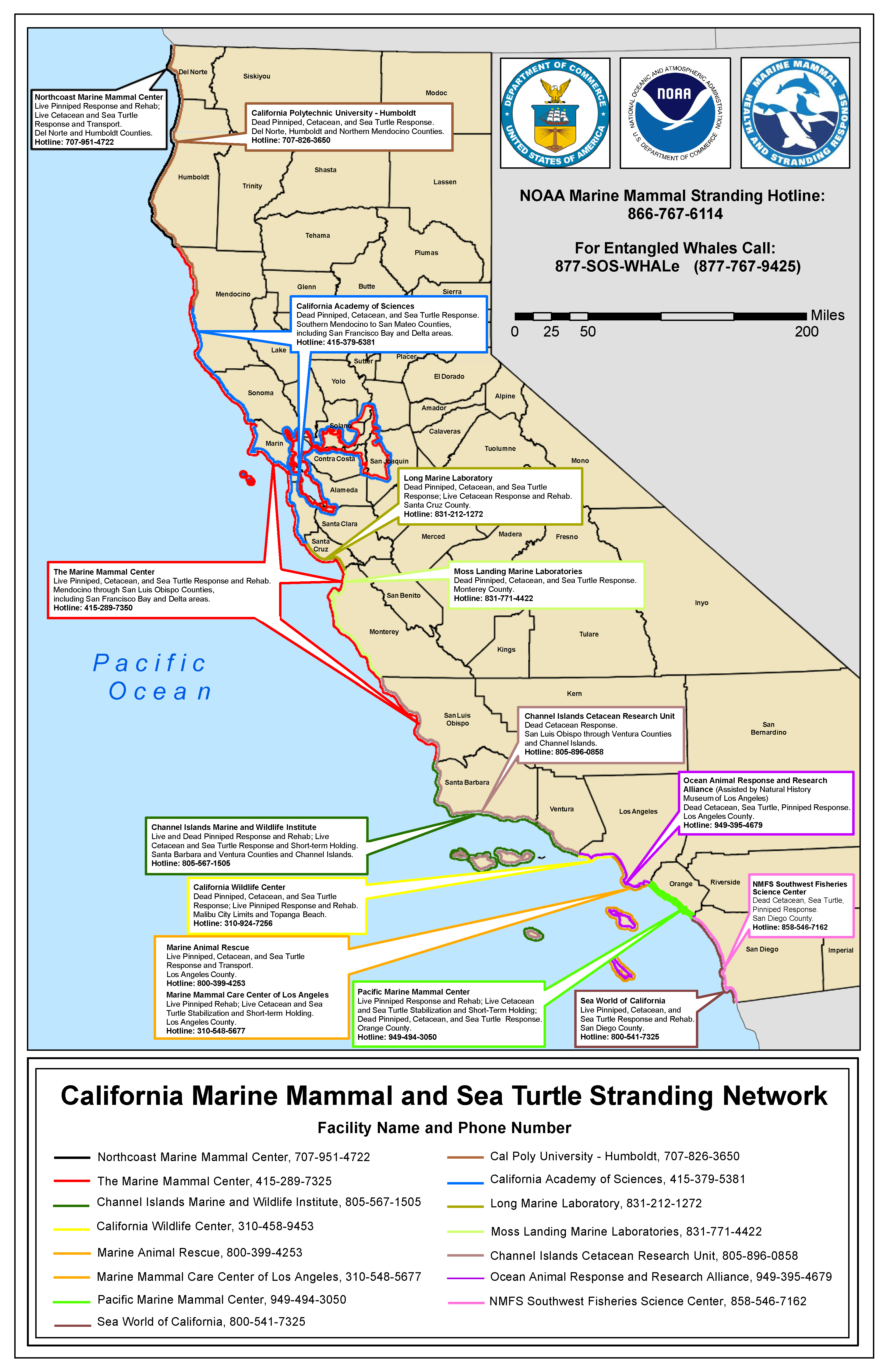
The Marine Mammal Center (TMMC), Channel Islands Marine Wildlife Institute (CIMWI), California Wildlife Center (CWC), Marine Mammal Care Center Los Angeles (MMCC-LA), Pacific Marine Mammal Center (PMMC), SeaWorld, and Southwest Fisheries Science Center (SWFSC) act like an emergency room by working to rescue and rehabilitate sick and injured marine mammals, seabirds, and sea turtles.
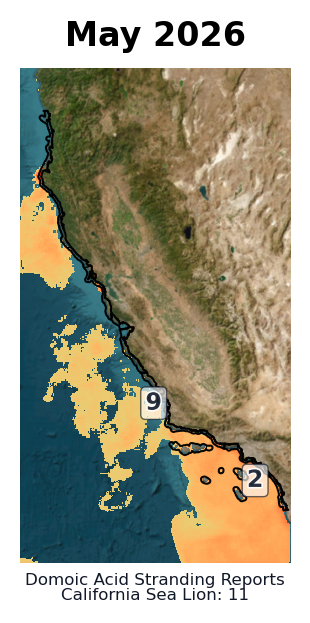
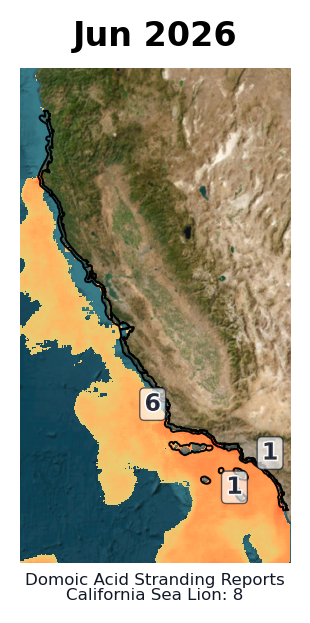
The maps above depict approximate county-level locations of domoic acid-related strandings of California sea lions, based on the reporting center. An overlay of C-HARM model output shows areas where the monthly average predicted probability of particulate domoic acid (pDA) exceeding the alert-level threshold of 500 ng/L was greater than 70%.
California's Marine Mammal Stranding Network Map
California HAB Bulletin
All data and reports have been synthesized by SCCOOS for the California Harmful Algal Bloom Monthly Bulletin.
Data Access & Resources:
C-HARM, NOAA CoastWatch ERDDAP
Toxic Phytoplankton Observations, CDPH
Imaging FlowCytoBot Dashboard
CalHABMAP Datasets, SCCOOS ERDDAP